Overview
Fossil raw materials and toxic substances are widely used in production processes in the chemical, plastics, and forestry sectors. The Cradle-Alp project will focus on replacing chemical, fossil or unsustainable materials with more circular, sustainable and biodegradable ones. The project will raise awareness and capacity of the public, relevant industries as well as policy stakeholders and business support organisations on cradle to cradle (C2C) approaches, circular design, and circular substitutions from the Alpine region. Transnational stakeholder groups will be formed, with the aim of transferring C2C roadmaps into industrial practice along exemplary value chains. Thus, Cradle-Alp will contribute to the industrial transformation and mainstreaming C2C approaches in the Alps.
Factsheet
- 2021 – 2027
- Carbon neutral and resource sensitive Alpine region
- SO 2.2 - Promoting the transition to a circular and resource efficient economy
-
- AG2 Economic development
- AG3 Labour market, education and training
- AG6 Natural resources
- AG7 Ecological connectivity
- AG9 Energy efficiency and renewable energy
- 11/2022
- 10/2025
- 1.953.970 EUR
- 1.405.478 EUR
Partners
- Lead partner
- Italy
- Veneto (ITH3)
- Padova
- Andrea Galeota
- progetti@pd.camcom.it
- Germany
- Karlsruhe (DE12)
- Horb a. N.
- Axel Blochwitz
- blochwitz@tz-horb.de
- Germany
- Oberbayern (DE21)
- Munich
- Stefanie Vogel
- vogel@chemiecluster-bayern.de
- Austria
- Wien (AT13)
- Vienna
- Raphaela Hellmayr
- Raphaela.hellmayr@boku.ac.at
- Austria
- Oberösterreich (AT31)
- Linz
- Ashna Mudaffer
- ashna.mudaffer@biz-up.at
- Italy
- Veneto (ITH3)
- Padova
- Stefano Giulitti
- stefano.giulitti@unismart.it
- Slovenia
- Zahodna Slovenija (SI04)
- Ljubljana
- Grit Ackermann
- grit.ackermann@gzs.si
- France
- Rhône-Alpes (FRK2)
- Oyonnax
- Annabelle Sion
- Annabelle.sion@polymeris.fr
- Switzerland
- Espace Mittelland (CH02)
- Fribourg
- Michael Keller
- Michael.keller@hefr.ch
- 45.407717211.8734455
- 48.44998048.6955714
- 48.137697511.5503216
- 48.236561416.3375091
- 48.318625214.306415972591235
- 45.406666711.8769111
- 46.071630214.514948852730125
- 46.25762719101015.65625081435249
- 46.79227817.1603362
Outcomes
-
Tools and methodologies supporting the uptake of digital and engineering technologies as well as the adoption of business models fostering C2C transformation in SMEs from the Alpine Space
DownloadCradle-ALP Toolbox for Cradle-to-Cradle TransformationWithin the Cradle-ALP project, a Cradle-ALP toolbox was developed as a set of methods and tools supporting SMEs and business support organisations in their transition towards a circular economy. The toolbox (explained in detail in D.1.4.3 C2C Guidance Book) provides practical approaches for assessing technological and organisational maturity, developing value chains, and designing business models that foster C2C transformation. Short toolbox overview:
Circularity Compass: Maps and visualises resource flows across particles, parts, and products to identify inefficiencies and opportunities for circular reintegration.
Life Cycle Assessment (LCA): Evaluates the environmental impacts of a product or service across its entire life cycle to identify hotspots and improve sustainability performance
Lego Serious Play (LSP): A facilitated workshop method that uses LEGO models to enhance communication, creativity, and collaborative problem-solving.
Audit / Maturity Assessment: Assesses an organisation’s current level of circularity implementation to identify strengths, gaps, and improvement opportunities.
Sustainable Business Model Canvas (SBMC): A strategic framework that integrates environmental and social considerations into how organisations create, deliver, and capture value.
Quick Scan: A two-phase tool that evaluates current business models and supports the development of future circular strategies and revenue models.
O.1.1 is connected to D.1.4.3.
-
Transnational multiple stakeholders, sector-based pilots aiming at implementing Cradle2Cradle transformative activities into industrial practice.
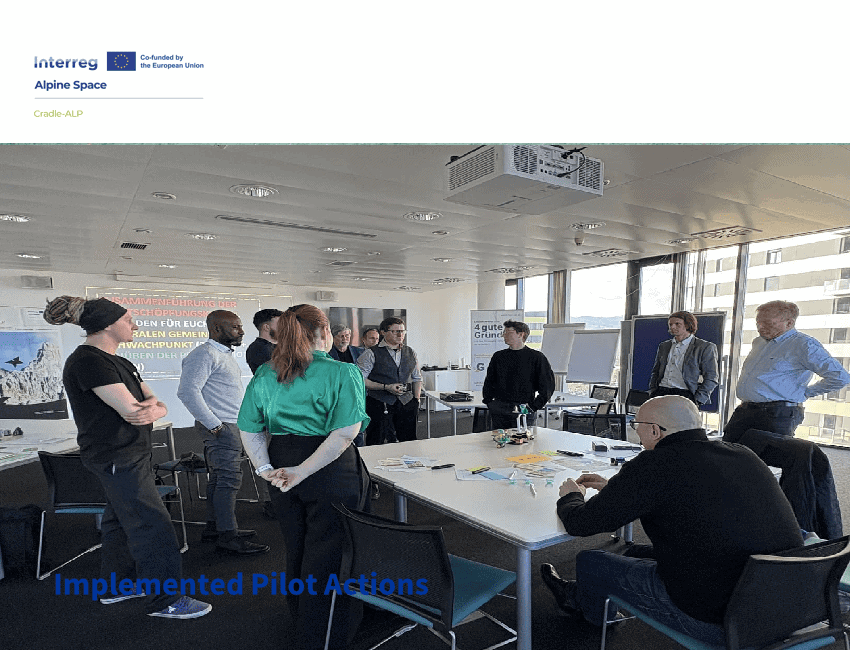
DownloadImplemented Pilot ActionsThe project partners piloted the application of sector-specific Cradle-to-Cradle transformation roadmaps in selected value chains across the Alpine Space. Through a mix of collective and individual activities, more than 130 SMEs were engaged in exploring circular strategies in sectors such as chemicals, polymers, packaging, textiles, and wood/furniture. A broad set of tools was applied (see outcome »Tools and methodologies«).
The pilots successfully fostered new collaborations (e.g., regional hemp fibre value chains), supported SMEs in testing circular business models, and introduced them to methods such as LCA and eco-design. Results show that direct support combined with network-based formats proved most effective, particularly for start-ups and younger companies. The activities laid the groundwork for cross-sectoral networks and transnational partnerships that will accelerate the transition to circular value chains in the Alpine region.
O.2.1 is connected to D.2.2.2.
-
From S3 to S4: policy convergence towards transnational S4 strategies in selected thematic areas from the project’s priority sectors.
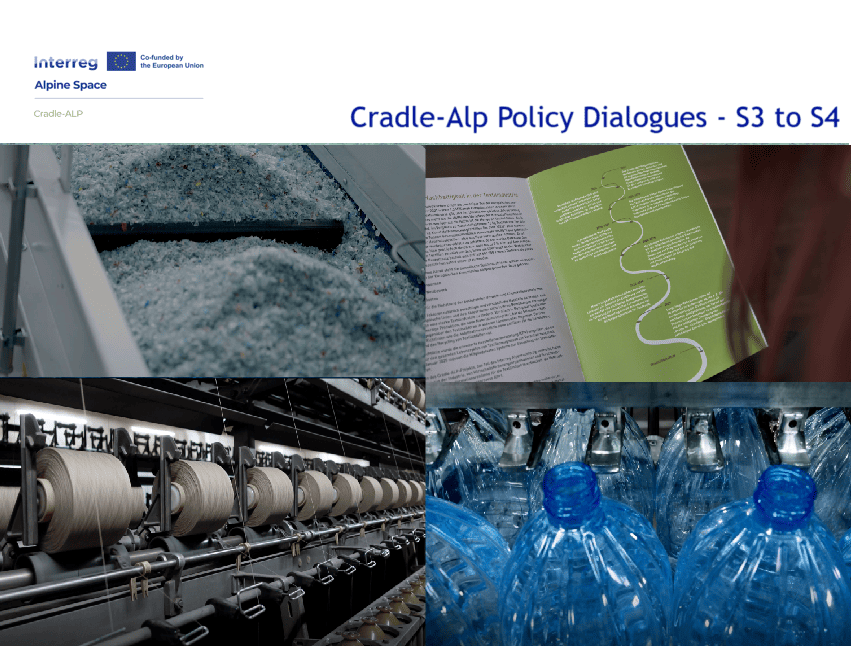
DownloadWithin the Cradle-ALP project, policy dialogues supported the transition from S3 to S4 in the Alpine Space Region. S4 strengthens Smart Specialisation by integrating sustainability and circular economy goals into regional strategies for green growth. Key challenges include new governance demands, stronger stakeholder cooperation, and limited awareness, requiring improved communication and uptake.
In the Alpine Space, key actions include SME support tools based on Cradle-ALP roadmaps, circular transition roadmaps across five sectors, and the development of a competence center in Fribourg for bio-based feedstock valorisation. These initiatives reinforce circular value chains and innovation ecosystems. S4 aligns with EU green and digital priorities, with project outputs informing future S3/S4 and ERDF strategies from 2026 onward.
Output 3.1 builds on local policy dialogues conducted by project partners at regional, national, and EUSALP levels to present Cradle-ALP results, assess the integration of circular approaches in S3 and funding programmes, and highlight the need for transregional cooperation.
O.3.1 is connected to D.3.2.2.
-
Common cross-border funding instruments aiming at fostering cradle to cradle and circular transformative activities Alpine Space in the priority areas of the project
DownloadWithin the Cradle-ALP project, four models for cross-border cooperation were defined by synchronizing regional and national funding schemes in the Alpine Space Region.
Model A enables international expertise via subcontracting with minimal administrative effort. Model B supports cross-regional projects within a shared consortium, where partners are funded by their own regions, requiring alignment of evaluation processes. Model C introduces joint calls between funding authorities with coordinated evaluations. Model D adds a joint coordination office to support matchmaking, funding advice, and long-term cooperation between funding bodies.
This output is based on D.3.3.2, which documents experiences and recommendations from Ardia-Net and INNOBIOVC Innovation Express Calls, and outlines practical options for transnational cooperation developed within Cradle-ALP. It is also closely linked to D.3.3.3 on supporting SME cross-border cooperation through public funding.
O.3.2 is connected to D.3.3.2 and D.3.3.3.
-
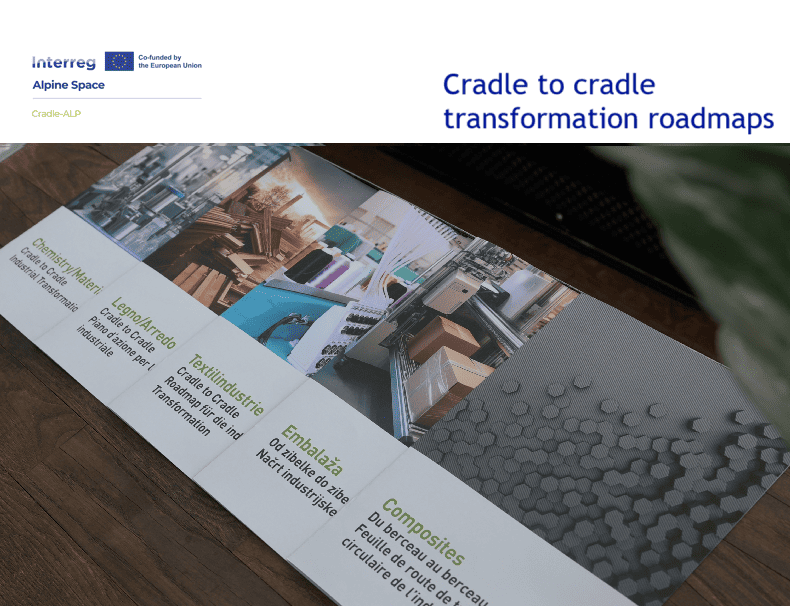
Cradle to cradle transformation roadmaps in selected value chains covering technologies and business models.
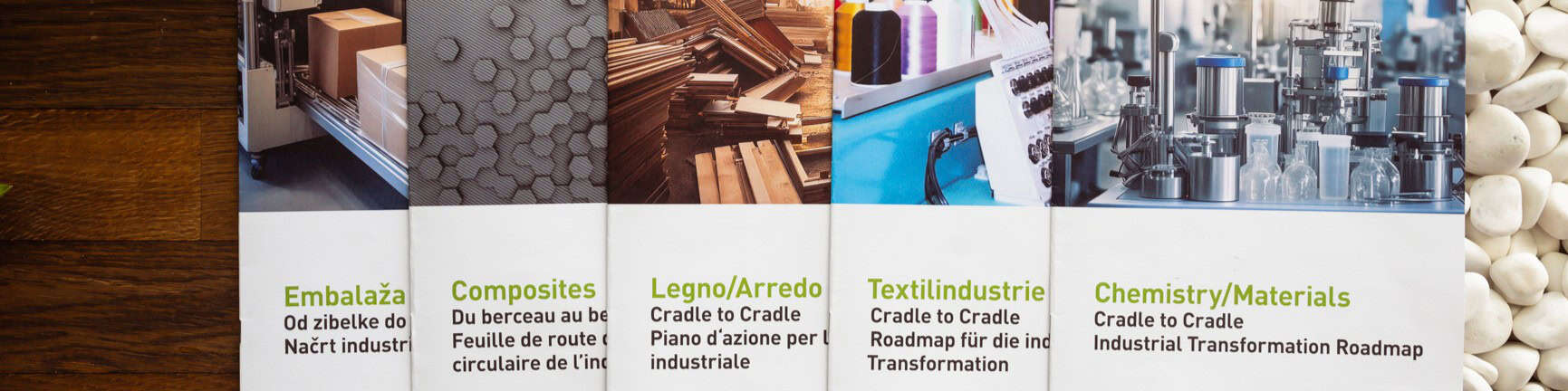
DownloadThe Cradle to Cradle transformation roadmaps aim to provide policymakers, business support organisations, and companies with structured, sector-specific guidance for the implementation of circular and cradle to cradle aligned business models. They outline concrete pathways to enable the transition across selected value chains, supported by phased actions from short- to long-term and illustrated through examples from industrial practice. Within the project, such roadmaps were developed for five key sectors: textiles, wood and furniture, packaging, chemistry/materials, and composites, serving as practical reference frameworks for piloting and scaling circular solutions.
Based on the five sector-specific roadmaps for textiles, wood and furniture, packaging, chemistry/materials, and composites, Cradle-ALP has prepared an integrated industrial transformation roadmap. This unified vision provides structured guidance for implementing circular and Cradle-to-Cradle (C2C) business models across all these value chains and broader.
O.3.3 is connected to D.3.1.3.
Videos
Gallery
Downloads
-
The European textile industry faces environmental and economic challenges, including low profit margins, strong international competition, and strict environmental regulations. A major issue remains textile waste, with nearly 7 million tons generated annually in Europe. In its roadmap brochure for the textile sector, the Cradle-ALP project outlines a structured transition towards a circular economy, presenting concrete measures for the short-term, mid-term, and long-term periods.Download
-
The polymer-based composites industry plays a crucial role in sectors such as aerospace, automotive, and construction. However, its reliance on complex composite materials poses significant challenges for recycling and waste management. In its roadmap for the composites sector, the Cradle-ALP project presents a transition strategy towards a circular economy, offering concrete measures for the short-term, mid-term, and long-term periods to reduce landfill disposal and enhance sustainability.Download
-
The European chemical and material industry is a key supplier for various sectors but faces significant challenges, including high energy consumption, dependency on fossil resources, and regulatory uncertainties. The transition to a circular economy is essential to reduce CO₂ emissions and increase sustainability. In its roadmap for the chemical and material sector, the Cradle-ALP project outlines a structured approach to achieving this transition, presenting concrete measures for the short-term, mid-term, and long-term periods.Download
-
The packaging industry is a major contributor to global waste, with paper, cardboard, and plastics accounting for a significant share. Despite efforts to improve recycling rates, waste generation continues to rise. In its roadmap for the packaging sector, the Cradle-ALP project outlines a strategic pathway towards sustainability, introducing concrete measures for the short-term, mid-term, and long-term periods to improve recycling, reduce environmental impact, and support circular economy principles.Download
-
The European wood and furniture sector is an important economic contributor but faces increasing pressure to adopt sustainable practices due to deforestation, climate change, and regulatory requirements. Waste management and resource efficiency are key concerns for the industry. In its roadmap for the wood and furniture sector, the Cradle-ALP project defines a transition framework towards circularity, presenting concrete measures for the short-term, mid-term, and long-term periods to promote sustainable sourcing, material recovery, and circular business models.Download
-
This transnational survey explores consumer perspectives on circular economy and Cradle to Cradle principles across Austria, France, Germany, Italy, Slovenia, and Switzerland. Conducted by BOKU University with input from all project partners, the survey gathered responses from 3,858 participants through an online questionnaire available in four languages. It aimed to assess consumer awareness, preferences, and acceptance of circular business models, comparing ownership-based models (buying) with use-based models (renting).Download
-
The Cradle-ALP Transnational Ecosystem Cradle to Cradle (C2C) Maturity Report provides an in-depth analysis of the adoption, challenges, and opportunities of C2C principles across the Alpine Space. The report consolidates insights from regional ecosystem maturity analyses, a transnational consumer survey, and a comparative study of policies, business support mechanisms, technologies, and business models. It focuses on five key industrial sectors: polymers/plastics, wood/furniture, chemistry/materials, fibers/textiles, and packaging.Download
-
This document provides an overview of tools designed to support businesses in adopting technologies that enhance circularity in products, services, and industrial processes, with a specific focus on closing material loops in line with Cradle to Cradle principles. The tools were identified and categorized within the Cradle-ALP project, focusing on two key areas: assessing transformation potential in businesses and facilitating transregional business-to-business collaboration and innovation projects.Download
-
The D.1.4.2 Toolset Business Models document provides a structured overview of tools designed to support the adoption of circular economy business models based on C2C principles. The toolset explores various methods to enhance circularity in business models, products, and services. It includes tools for identifying and documenting transformation potential within businesses, fostering B2B collaboration and innovation, and promoting certification and awareness around sustainability. The document also presents practical applications, real-world examples, and best practices from various industries, making it a useful guide for businesses, policymakers, and stakeholders interested in integrating circular economy principles into their operations.Download
-
This deliverable presents the Cradle-ALP C2C Guidance Book, which provides practical descriptions of key tools supporting cradle-to-cradle and circular economy transformation in SMEs. The guidance covers a set of complementary methods - including LEGO® SERIOUS PLAY®, Life Cycle Assessment (LCA), Circularity Compass, Sustainable Business Model Canvas, maturity and audit tools, and the QuickScan for circular business models - explaining their purpose, application, implementation steps, and benefits. By combining strategic, analytical, and participatory tools, the guidance book supports companies at different stages of their circular transition, helping them assess their current position, identify improvement opportunities, and design sustainable, future-oriented business models aligned with C2C principles.Download
-
This transformation roadmap addresses the role of chemical additives in circular economy practices, focusing on adhesives, coatings, pigments, and flame retardants. The strategy prioritizes phasing out hazardous substances, increasing the use of bio-based and recyclable alternatives, and improving lifecycle assessments. Challenges include regulatory complexities, lack of investment in sustainable chemistry, and technological limitations in recycling processes. The roadmap presents a structured plan with specific technological, business, and policy-related solutions, offering SMEs guidance on integrating C2C principles. The Roadmap Brochure: Chemistry and Materials is a key outcome of this process, summarizing essential strategies to support industrial transition.Download
-
This roadmap provides a framework for reducing landfill disposal of composite materials to less than 10% by 2035, in alignment with EU sustainability targets. It identifies major challenges such as material complexity, limited recycling technologies, and the high costs of bio-based alternatives. The strategy includes eco-design for recyclability, advancements in composite separation technologies, and improved collaboration across value chains. Workshops and expert input helped shape a roadmap with clear short-, mid-, and long-term actions to facilitate a circular future for polymer-based composites. The Roadmap Brochure: Composites is the final output of these efforts, making key insights easily accessible for businesses and stakeholders.Download
-
This roadmap provides a strategic framework for transforming the packaging industry towards circular economy principles, focusing on paper and plastic packaging. It consolidates findings from industry workshops and expert consultations, identifying key challenges such as high production costs, regulatory uncertainties, and technological limitations in recycling and material sourcing. The roadmap emphasizes eco-design, material innovation, and enhanced collection and recycling systems. It also explores the integration of the Cradle to Cradle certification and outlines short-, mid-, and long-term strategies to support businesses in adopting sustainable practices. The Roadmap Brochure: Packaging is a direct result of these efforts, translating key findings into an accessible and actionable format.Download
-
This roadmap focuses on non-fashion textiles and functional wear, addressing challenges such as low recycling rates, fiber contamination, and inadequate sorting infrastructure. It sets an ambitious vision for 50% of textiles in the EU to be made from recycled or renewable materials by 2030. The document highlights the need for advanced sorting technologies, business model innovation, and regulatory frameworks that promote circular design. It also outlines strategic actions for collection, reuse, and recycling, providing SMEs with concrete steps towards sustainable textile production. The Roadmap Brochure: Textile is the direct result of this work, helping industry stakeholders translate circular economy principles into concrete action.Download
-
This roadmap outlines a vision for circular transformation in the wood and furniture industry, leveraging the Alpine region’s natural resources and technological potential. The strategy focuses on sustainable material sourcing, reducing waste, and integrating digital tools to enhance circularity. Key challenges include supply chain inefficiencies, lack of consumer awareness, and regulatory ambiguities. The roadmap proposes solutions such as bio-based materials, modular product design, and improved recycling systems, structured into short-, mid-, and long-term implementation phases. The goal is to establish a fully circular wood and furniture sector by 2035. The Roadmap Brochure: Wood and Furniture is the result of this collaborative effort, offering businesses and policymakers clear guidance on implementation.Download
-
This deliverable reports on the peer-based monitoring and coaching activities carried out within the Cradle-ALP pilot actions across five industrial sectors: chemistry/materials, polymers, packaging, textiles, and wood/furniture. It documents how Transnational Sectoral Working Groups (TSWGs) coordinated and monitored the application of the C2C transformation roadmap and toolbox through regular meetings, peer exchange, and joint reflection on challenges and solutions. The report highlights the use of both individual coaching tools and collective activities—such as workshops, matchmaking events, and company visits—to support SMEs in their circular transition. Overall, the deliverable demonstrates that while individual support services required targeted and personalized engagement to attract SMEs, collective formats proved particularly effective in fostering cross-sectoral learning, transnational collaboration, and the uptake of cradle-to-cradle approaches in the Alpine Space.Download
-
This deliverable reports on the application and testing of the Cradle-ALP cradle-to-cradle (C2C) industrial transformation roadmaps and toolbox across five priority sectors: chemicals, polymers/composites, packaging, textiles, and wood/furniture. Through a combination of collective activities (matchmaking events, workshops, company visits) and tailored one-to-one support, project partners worked with more than 250 SMEs and research organisations to translate sector roadmaps into practical action. The testing demonstrated that hands-on tools such as QuickScan, Life Cycle Assessment, and collaborative workshops are effective in supporting SMEs - particularly start-ups and younger companies - in developing circular business models and cross-border partnerships. Overall, the deliverable confirms strong interest in circular transformation in the Alpine region, while highlighting the need for targeted support, incentives, and policy backing to scale implementation.Download
-
Download
This deliverable presents the consolidated evaluation of the Cradle-ALP pilot actions based on a structured survey addressed to pilot implementers across the consortium. The report analyses SME engagement, communication strategies, barriers encountered, activity formats, and the performance of tools such as QuickScan, Circularity Compass, and LCA. The findings highlight uneven SME readiness, strong preference for personalised one-to-one support, and recurring constraints related to time, resources, and perceived complexity. Overall, the evaluation confirms the effectiveness of the pilots in raising awareness and supporting initial circular transformation steps, while providing evidence-based recommendations to refine future roadmaps, engagement models, and policy actions in the Alpine Space.
-
This publication presents the outcomes of the Cradle-ALP project, an Interreg Alpine Space initiative aimed at supporting the transition of SMEs in the Alpine region from linear production models to circular, cradle-to-cradle (C2C) value chains. Working across five priority sectors—chemicals and materials, polymers and composites, packaging, textiles, and wood and furniture—the project developed and tested practical tools, transformation roadmaps, and collaborative formats with more than 250 companies and research organisations. Through workshops, matchmaking events, and tailored mentoring, Cradle-ALP helped SMEs adopt circular design, life-cycle thinking, and innovative business models. The publication highlights concrete pilot results, success stories, and policy insights, concluding with recommendations to strengthen networks, align funding, and scale circular industrial transformation across regions.Download
-
This deliverable documents the Cradle-ALP local policy dialogues conducted across seven regions in the Alpine Space to support the integration of cradle-to-cradle (C2C) and circular economy approaches into Smart Specialisation Strategies (S3/S4) and regional funding frameworks. The dialogues engaged regional and national policymakers, funding authorities, and innovation intermediaries to present project results, sectoral roadmaps, and pilot learnings, while exploring opportunities for transregional cooperation and synchronized funding schemes. The discussions highlighted both the strategic relevance of C2C for industrial transformation and the practical challenges of aligning funding instruments across regions. Overall, the deliverable provides key insights and recommendations for improving policy coherence, enhancing programme flexibility, and leveraging existing funding mechanisms to better support SME-led circular transformation in the Alpine Space.Download
-
Download
This deliverable outlines the coordination activities between the Cradle-ALP project and the EU Strategy for the Alpine Region (EUSALP), highlighting how project actions align with macro-regional priorities. It describes the strategic relevance of EUSALP pillars and cross-cutting priorities—particularly circular economy, digitalization, and resource efficiency—and their connection to Cradle-ALP objectives. The document details collaboration with several EUSALP Action Groups (notably AG2, AG3, AG6, and AG7), including bilateral exchanges, participation in meetings, and awareness-raising activities to ensure policy coherence and long-term impact. Overall, the deliverable demonstrates how Cradle-ALP contributes to and reinforces EUSALP’s policy cycle, supporting synchronization of funds and strengthening circular transition strategies across the Alpine region.
-
This deliverable analyses experiences with transnational fund synchronization and proposes practical models for supporting SME investments in cradle-to-cradle (C2C) and circular economy solutions across the Alpine Space. Building on lessons from the ARDIA-Net and INNOBIOVC Innovation Express calls, as well as insights from local policy dialogues and advisory board discussions, it outlines the opportunities and limitations of synchronized funding schemes. The report presents a set of viable cooperation models—ranging from bottom-up subcontracting and project-level collaboration to fully synchronized joint calls - highlighting the importance of flexibility, early stakeholder involvement, and strong matchmaking support. Overall, the deliverable provides concrete recommendations for policymakers and funding authorities to enable transregional SME cooperation using existing regional and national funding instruments.Download
-
This deliverable outlines criteria and practical schemes to trigger SME cross-border cooperation through public funding, building on experiences from previous Innovation Express Calls. It presents models for synchronized funding without creating new programs, including a joint Swiss university call and a German national scheme allowing international partners. The report concludes that while fully synchronized calls are challenging, pragmatic approaches - such as bottom-up cooperation, subcontracting, and flexible use of existing national and regional instruments - are effective ways to support transnational SME collaboration.Download
-
This deliverable summarizes the 2nd Cradle-ALP Advisory Board meeting and local policy dialogues on synchronizing existing funding programs to support circular economy and cradle-to-cradle activities. It shows that while synchronized funding can foster transregional cooperation, it is administratively complex and often difficult to implement. The report concludes that more feasible alternatives include bottom-up cooperation, matchmaking, subcontracting, and flexible use of existing funding instruments, illustrated by practical examples from Switzerland and Italy.Download
More
Here you can access all public deliverables of the Cradle-ALP project:
D.1.1.1_Establishment of the transnational expert support group
D.1.1.2_Good practices and lessons learned
D.1.1.3_Capitalisation workshops for policies, technologies and business models
D.1.2.1 Regional ecosystem Cradle2Cradle maturity analysis_SLOVENIA
D.1.2.1 Regional ecosystem Cradle2Cradle maturity analysis_ITALY_Veneto region
D.1.2.1 Regional ecosystem Cradle2Cradle maturity analysis_GERMANY_Bavaria
D.1.2.1_Regional ecosystem Cradle2Cradle maturity analysis_FRANCE_Auvergne-Rhône-Alpes
D.1.2.1_Regional ecosystem Cradle2Cradle maturity analysis_SWITZERLAND
D.1.2.1_Regional ecosystem Cradle2Cradle maturity analysis_AUSTRIA
D.1.3.2_Transnational_online_awareness_campaigns_report
D.2.1.1 External experts support group meeting
D.2.1.2_TSWG Chemistry_Materials
D.2.1.2_TSWG Polymer_Composites
D.2.2.3_Pilot communication campaign
D.3.1.2_Report on transregional event
D.3.2.1_Advisory Board establishment and action
D.3.2.4_Conference on Industrial C2C transformation
D.3.3.1_CompMaps_local+national funds_trigger Circularity in Industry_final
Project calendar