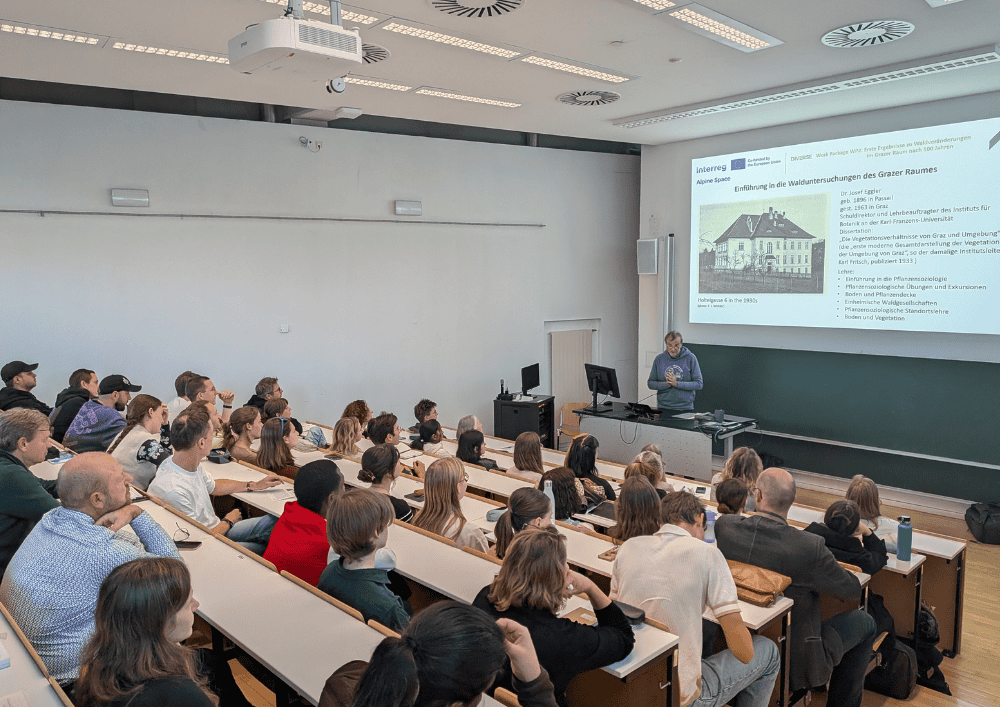
On 14 October 2025, forests took centre stage in Styria as the DIVERSE project partners brought together researchers, public authorities, businesses, and citizens for a workshop and networking event dedicated to understanding how forest management has shaped plant biodiversity in the Greater Graz area over the past century.
With 56 participants from sectoral agencies, SMEs and enterprises, local public authorities, public service providers, and the general public, the event created a lively space for dialogue between science, policy, and practice. The workshop aimed not only to present initial research findings, but also to encourage discussion on how economic activities and biodiversity conservation can be better aligned.
Setting the scene: forests between economy and biodiversity
The event opened with an introduction to the DIVERSE project and its overarching goal: reconciling economic objectives—such as energy production and forest use—with the need to protect and enhance biodiversity. Participants were introduced to the project’s pilot activities and focus labs, practical formats designed to test innovative solutions in real-life contexts. Examples from other pilot regions helped illustrate how local actions can contribute to broader European biodiversity and energy goals.
The spotlight then shifted to the Styrian pilot activities, which formed the core of the day’s programme.
Part 1: energy, wood, and local communities
The first pilot activity focused on combined heat and power (CHP) plants and their integration into an energy community. The pilot project was presented in detail, explaining its concept, relevance for the region, and potential benefits—such as increased energy efficiency and local value creation. At the same time, the speakers addressed the associated costs and challenges, offering an honest outlook on barriers and possible solutions. This forward-looking perspective was designed to spark interest and prepare participants for deeper discussions in upcoming focus labs.
Part 2: looking back to understand today’s forests
The second pilot activity took participants on a journey through time, exploring plant diversity in the forests of Greater Graz—both today and 100 years ago. Researchers presented the sampling methods used to compare historical and current forest data, revealing how plant species composition has evolved over the last century.
Initial results highlighted the complex relationships between forest management practices, economic structures, topography, and site characteristics. Rather than pointing to a single cause, the findings showed how multiple factors interact to influence biodiversity, offering a more nuanced understanding of forest ecosystems.
Part 3: a hands-on Workshop on biodiversity
The day concluded with an interactive workshop that invited participants to reflect on key biodiversity questions. Discussions addressed the anthropocentric role of forests—as sources of timber or ecosystem services—and how these functions can sometimes conflict with ecological health.
Participants also debated the difficulty of isolating the effects of forest management from other influences, such as changing land use, topography, or economic conditions. A particularly lively discussion emerged around whether plant diversity alone is a sufficient indicator of ecosystem health, or whether additional metrics are needed.
Other topics included the increase of neophytes linked to forest fragmentation and their impact on biodiversity and microclimate, as well as local policies aimed at defragmenting forests to support more resilient ecosystems.
A space for dialogue and future action
By combining scientific insights with open discussion, the workshop demonstrated the value of collaborative approaches to complex environmental challenges. The event not only deepened understanding of how forests around Graz have changed, but also laid the groundwork for future dialogue and action within the DIVERSE project.
As the project moves forward, the insights gathered in Styria will contribute to shaping more biodiversity-friendly forest and energy strategies—locally and beyond.