

The picture is a schematic representation of a perialpine lake and its catchment, with indication of major climate and human-related catchment processes, which can directly or indirectly affect lake ecological dynamics. Internal lake processes involving the deep lake sediments are also shown.
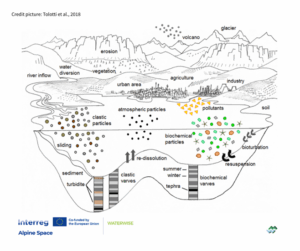
The drawing was done by M. Tolotti (FEM), for the paper “Large and deep perialpine lakes: a paleolimnological perspective for the advance of ecosystem science” (Tolotti et al. 2018).
It is possible to understand at first glance how what happens higher in the mountains has a repercussion downstream: a first glance is sufficient to grasp the influence of what happens high in the mountains over the processes downstream, including those occurring at the interface lake water-deep sediment. The principal physical and chemical processes occurring in the lake sediments are shown here.
Alpine and perialpine lakes are affected by climate change-induced meteorological events, such as increasing temperature, longer dry spells in the Summer, reduction of seasonal rainfall and snow. Due to different management, transnational situations and/or inadequate knowledge about local/regional land and water conditions, understanding and sustainably managing headwaters and lowland water resources is often complex.
Here comes the project Waterwise: by gathering and harmonizing local water data, the project aims at helping the drawing of a better picture of the water resources at local level, as well as the planning of long-term and sustainable water management.