
The Alpine space is rich in peatlands, rivers, and lakes; all water bodies considered inland wetlands, all threatened by climate change.
On World Wetlands’s Day (on February 2) it is important to underline their importance in preserving ecosystems, Alpine biodiversity, and the role they play in water management for local communities.
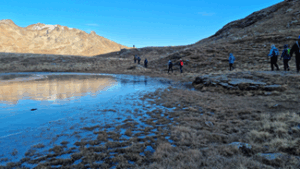
A seasonal bog in an Alpine enviroment
One of Waterwise’s goals is to integrate ecosystem needs into headwaters quantitative water management and to adapt ecosystem management to the new challenges brought on by climate change; an important part of our research is about protecting and promoting connectivity between environments, essential to sustainably manage the hydric resource on the long-term.
Priorities for the scientific community related to climate change in Alpine areas are changing: if, once, they focused on protecting a few animal or plant species, now they strive to include in their priorities protecting an entire socio-ecosystem.
Wetlands and watersheds are part of the water resources investigated by our project. Data collection and harmonization is an important part of the toolbox development, as they provide a first look at the present situation and support land and water managers, local administrators and other stakeholders to better organize the water management.
Data gathered from surface wetlands draw a picture of the groundwater situation. During certain periods of the year, when rainfall is less and more scattered, the connectivity of peat bogs and their hydrogeological basin is decreasing, with a consequential decrease in their water supply. As high-altitude watersheds headwaters are more affected than others by climate change and harbor endemic species that are declining and can’t be relocated to different areas, they are in need of an organized water resource management specific to their situation.
Waterwise final outcome, one that will hopefully prove to be a useful tool for local administrations for the years to come, will thus not only support planning water management strategies for socio-economic activities, but will also play a part in protecting Alpine biodiversity and ecosystems. Once again, a remark of the unbreakable connection between us and the environment we live in.