From Italy to Lyon, a three-day full-immersion mission brought the Woolshed community into direct contact with advanced digital textile fabrication at Le Textile Lab. The mission focused on the use of the Kniterate digital knitting machine within a collaborative makerspace dedicated to responsible and innovative textile design. The experience was conceived to explore how accessible digital knitting technologies might support artisans working in rural areas, where production is often constrained by limited infrastructure, fragmented processes and a strong dependence on manual expertise.
The activity addressed one of the core ambitions of the Woolshed project: to revitalise Alpine wool value chains through research, innovation and the uptake of advanced yet accessible technologies, while opening new applications for coarse and rustic fibres that are still largely underused. In line with the project’s broader strategy, the mission examined whether digital fabrication could help optimise selected phases of small-scale wool production, strengthen economic sustainability and expand the practical and commercial uses of local wool beyond traditional fields.
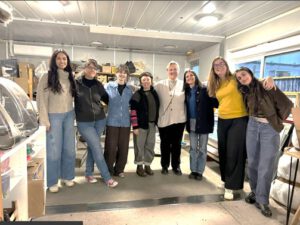
The working group involved four participants from Italy with complementary expertise in digital fabrication, design, breeding, natural dyeing, weaving and local wool processing, alongside the Le Textile Lab team and resident experimenters connected to Fabricademy. This mix of profiles made the mission especially valuable, not only from a technical point of view, but also as a meeting point between artisanal knowledge, material research and computational textile design.
Rather than being organised as a conventional training course, the three-day agenda was structured around a concrete design challenge. Starting from a handmade dog sweater prototype developed in the context of the Woolshed design marathon, the group worked to translate an artisanal garment into a computational knitting pattern suitable for Kniterate production. This project-based approach created the conditions for genuine learning-by-doing, enabling participants to engage directly with software logic, machine settings, yarn behaviour and pattern construction while solving an actual design problem.
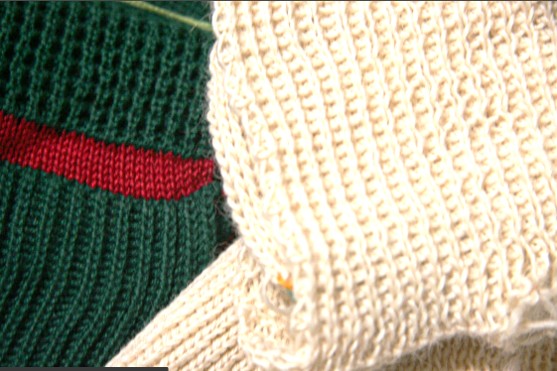
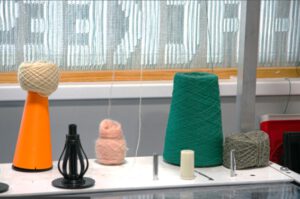
The first day was devoted mainly to machine familiarisation and yarn sampling. Different rustic yarns were tested, including grey Alpago wool yarn and several Brogna and Lamon wool variants, in order to identify suitable tensions, feeding conditions and stitch structures. Interlock, rib, links and Milano constructions were explored, showing how each yarn required specific adjustments and how computational parameters directly affect textile behaviour.
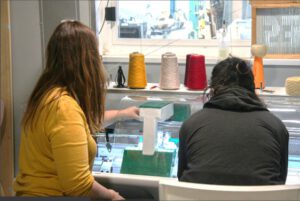
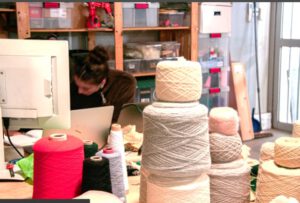
The second day opened up the mission to broader exchange within the makerspace. Participants took part in knowledge-sharing sessions on wool washing through fermentation, natural dye printing using laser-cut wooden stamps, textile paper production from shredded fabric waste, and experimental recipes for rigid wool-based acoustic materials. These sessions made visible the makerspace as an environment of open innovation, in which technical know-how, material experimentation and design thinking circulate across disciplines. In the second half of the day, work on the Kniterate resumed, with the most promising knitted samples being scaled up into more articulated textile forms.
The third day concentrated on the development of the digital dog sweater prototype. Stitch calculations, increases and decreases were tested in order to define shape and fit. This stage proved particularly demanding, especially because the rib structure required by the design generated technical difficulties in shaping the garment. The group had to proceed through several iterations and trial-and-error cycles before obtaining a stable file, gaining first-hand insight into both the opportunities and the limits of digital knitting when working with coarse, irregular and locally sourced wool yarns.
Beyond the technical outcomes, the mission highlighted the importance of shared infrastructures for learning and innovation. For artisans coming from predominantly rural and craft-based contexts, the possibility to work inside an open, interdisciplinary textile makerspace reduced the barrier often associated with software-driven fabrication. Seeing others experiment, fail, adjust and improve fostered a more confident and exploratory attitude towards digital tools. The experience therefore confirmed that collaborative environments can function as enabling infrastructures for skill transfer, peer learning and accelerated experimentation.
A key reflection emerging from the mission concerns geography. In this case, rural practitioners accessed innovation by travelling to an urban makerspace. While this proved highly effective for a short-term immersion, it also reinforced the strategic relevance of developing decentralised spaces able to host similar dynamics within rural territories themselves. In this perspective, the idea of a future Woolshed Factory becomes especially significant: a place where breeders, fibre processors, artisans, designers and makers can access digital tools close to the territories where wool is produced, processed and culturally embedded.
The Lyon mission therefore represents more than a technical visit. It stands as an exploratory step towards new forms of territorial infrastructure for the Alpine wool sector: hybrid spaces where traditional material knowledge and digital fabrication can meet, where local fibres can be tested for new uses, and where more resilient, collaborative and geographically rooted wool economies can begin to take shape.

Programme events

Project events