
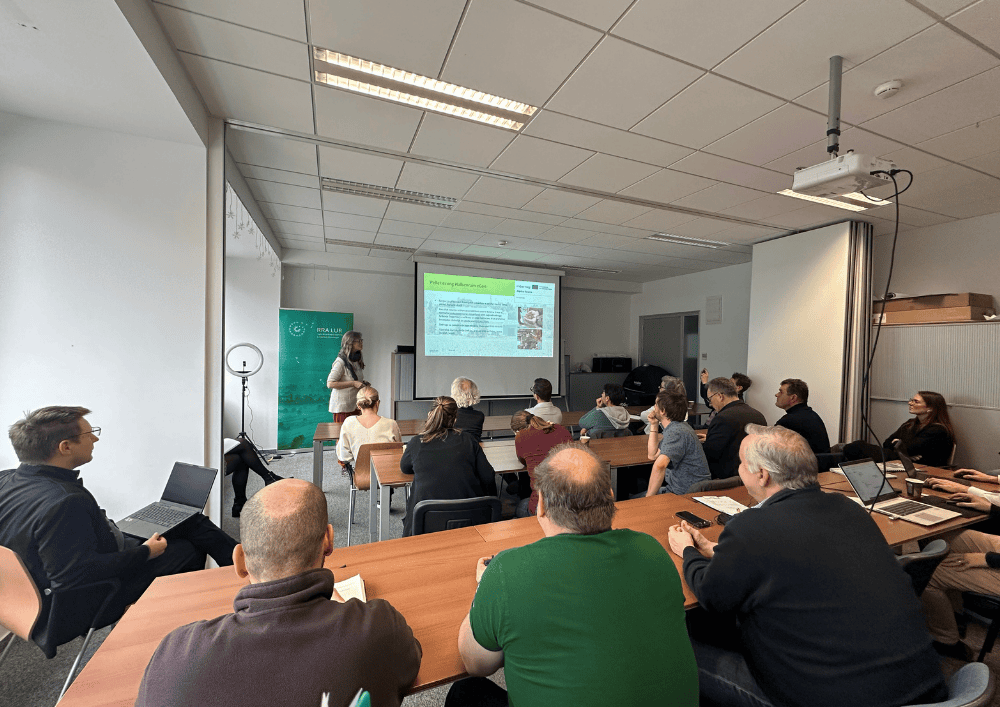
On February 11, the Regional Development Agency of the Ljubljana Urban Region (RRA LUR) and the Ljubljana Marsh Nature Park (JZ KPLB) hosted a Focus Lab within the framework of the DIVERSE project. The event brought together key stakeholders from the agricultural, energy, and conservation sectors to address the management of biomass generated through nature conservation measures, such as late mowing. The primary objective was to stimulate joint reflection on feasible systemic solutions that align biodiversity protection with the technical and economic realities of the green transition.
Technical Potential and Economic Viability
Technical sessions presented analyses of hay samples from the Ljubljana Marsh, confirming that grassland biomass from late-mowing measures possesses significant potential for energy use. Experts from the National Institute of Chemistry and the Faculty of Mechanical Engineering highlighted that, with appropriate processing, this biomass reaches calorific values comparable to conventional fuels. However, the discussion emphasized that technical feasibility alone does not guarantee implementation; the development of a sustainable business model remains the central challenge.
Currently, the pilot focuses on approximately 135 hectares of protected land, producing roughly 600 tonnes of biomass annually. Participants explored whether local energy use for public buildings or the production of pellets and briquettes could be economically viable. The dialogue underscored that biodiversity conservation and compliance with regulatory frameworks, such as the RED III Directive, remain the priority, yet long-term sustainability is impossible without a sound economic rationale that reduces dependency on public funding.
Policy Alignment and Future Steps
The Focus Lab underscored the necessity of coordinated energy, agricultural, and environmental policies to support stable business models. Insights from other regional parks demonstrated that while various material and energy pathways have been explored, they require clear governance and long-term stability. The dialogue effectively bridged the gap between the operational realities of farmers and strategic regional policy goals.
The outcomes of this meeting will serve as the foundation for a follow-up session in March 2026, which will focus on specific economic scenarios and concrete implementation steps. The goal is to establish the Ljubljana Marsh as a reference case for integrating nature conservation, local energy self-sufficiency, and efficient public spending within the Alpine Space.