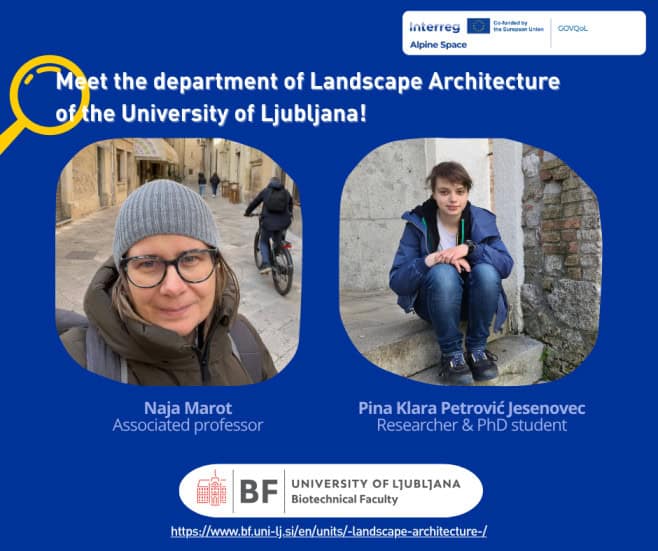
Meet the coordinating team of GOVQoL from the University of Ljubljana!
Within the Biotechnical Faculty of the University of Ljubljana, Naja Marot is an associated professor teaching regional planning and territorial governance and doing research in policy analysis; and Pina Klara Petrović Jesenovec is a researcher in the Department of Landscape Architecture, as well as being a PhD student of geography. Naja Marot was leading the expert group in charge of the preparation of the 10th Report on the State of the Alps published in 2025, from which the idea of the GOVQoL project stems as a way of bringing the report’s recommendations concerning governance to practice on the local level.
What would be your personal definition of »Quality of life«?
Pina Klara: Quality of life is a whole world of opportunities, as well as the environmental assets which enables you to grasp them (i.e. shelter, water access, safety, privilege to work/study/benefit from cultural events/access shops, …).
Naja: For me, quality of life is related to the time spent with family and friends, my social relations, on top of the fact that we are free and can travel around, and that we can rely on good working conditions. In a nutshell, it is the daily basis of how my day rolls out that translates into my level of quality of life.
In your own words, what is your role in the GOVQoL project?
Naja: As a coordinator, I supervise the overall approach of the project and steer project activities in the direction designated in the project application. As an academic partner, University of Ljubljana brings scientific value to the results of the project, along with Politechnico di Torino. I have built the partnership knowing it would be a mixed group of scientific partners and Alpine networks – Alliance in the Alps and CIPRA France – which helps us keep an overall coherence between all the results and reach the local level sufficiently.
Pina Klara: I, as a researcher who works for University of Ljubljana, am in charge of the work on the local level in Slovenia which has so far included interviews with municipalities, various exchanges with supporting pilot territories, organising and analysing workshops, and others.
Why do you consider this level of governance important for quality of life?
Naja: The 10th Report on the State of the Alps was put together in just under 18 months which was a very short time-frame for such a complex study – thus, we “only” had time to cover governance aspects related to supranational, national and regional level. There was no time to investigate the local level, although, it is a crucial level of governance as municipalities are the “end-users” of policies designed within the levels above, and are also in direct contact with all the different stakeholders, relevant to quality of life.
Pina Klara: It is also interesting to study the local level because even though they may be comparable on some criteria (population, size, altitude, …) and they are supposed to align on the same administrative organisation, there is always a local specificity in their organisation/how local populations interact.
Did you know?
Slovenia is the only EU Alpine country without the NUTS2/regional administrative level. However, municipalities come together and cooperate, for instance, to agree on regional climate action plans.
Thanks Pina Klara and Naja!
Learn more about the Biotechnical Faculty’s activities here: www.bf.uni-lj.si/en/units/-landscape-architecture-/