
This year’s symposium of the Alpine-wide network of municipalities, Alliance in the Alps theme of the conference was ‘Strong together! Cooperation as the key to resilient communities, and it became clear in the many discussions, presentations, workshops and on an excursion during the conference that many things are much easier when done together.
This was confirmed by the four mayors of the Kumma region: Gerd Hölzl (Mayor of Koblach), Daniel Schuster (Mayor of Mäder), Manfred Böhmwalder (Mayor of Götzis) and Markus Giesinger (Mayor of Altach) reported on their active cooperation in many areas during a panel discussion moderated by Katharina Gasteiger, Managing Director of Alliance in the Alps. They coordinate their youth work, network on the issue of elderly care and jointly organise refugee accommodation. “Every form of cooperation is important – we want to keep the structures as flat as possible. People must want to cooperate; cooperation must grow and cannot be dictated from above,‘ said Manfred Böhmwalder. Daniel Schuster added: ’The foundations for our cooperation in the region were laid decades ago, and we can continue to build on them.” Markus Giesinger cited the pump track as a concrete example of where cooperation works excellently: ‘The costs were divided according to population size, maintenance is financed by the region – and the facilities are used intensively by young and old throughout the Kumma region.’ Gerd Hölzl added what else is needed for a well-functioning cooperation: ‘It is important to set guidelines for yourself, for example for a spatial development concept. This allows you as a municipality to refer to cornerstones, for example for greening flat roofs.’
You can find the details from the first day of the conference HERE.
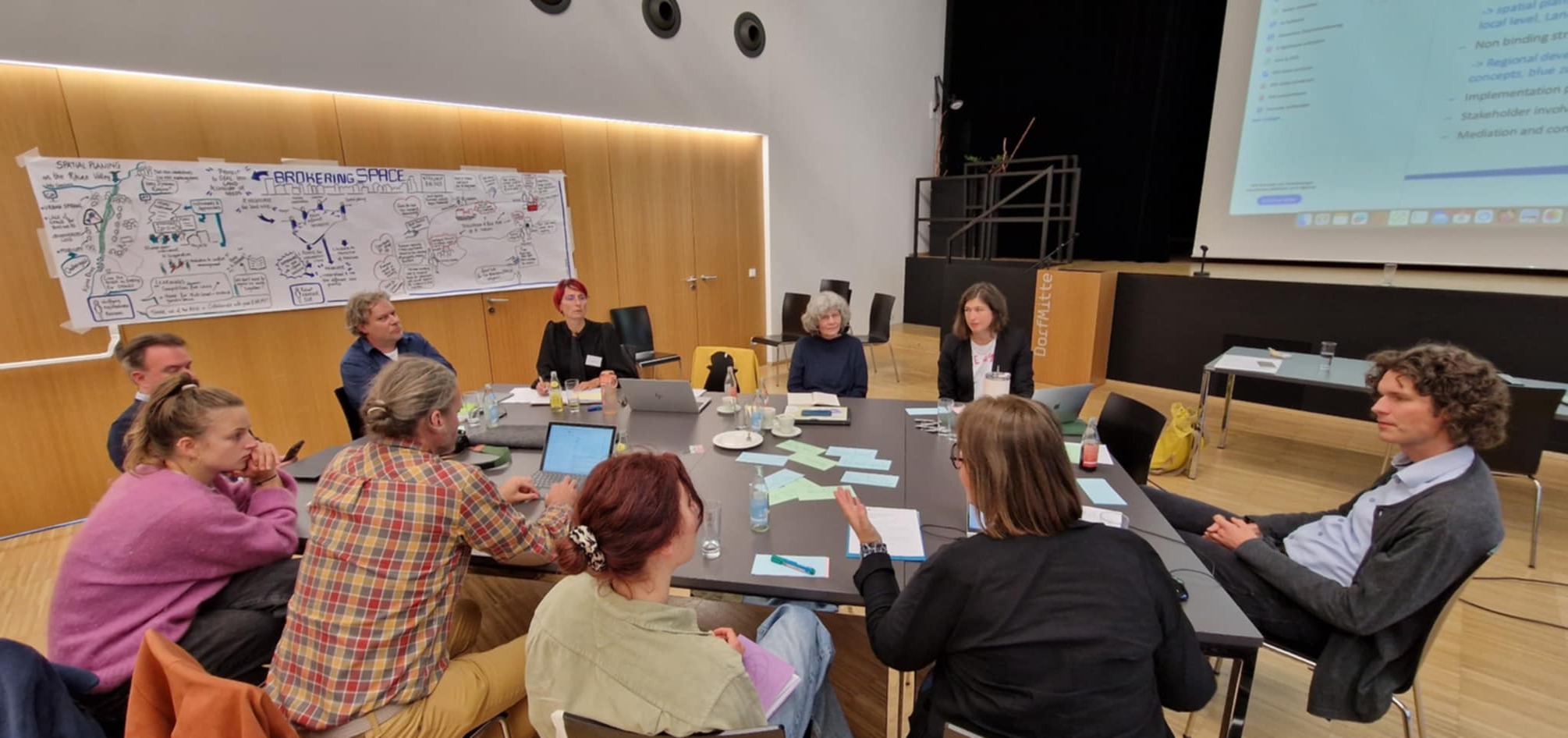
The next day, a BrokeringSpaces workshop was held, yielding very interesting insights.
Our project partner, Salzburg Institute for Spatial Planning and Housing (SIR) – Robert Krasser presented the idea behind the joint project to the audience in his lecture: What conflicts exist? Who are the parties involved in the conflicts? Are there possibly even areas of overlap?
This was followed by group work with sometimes heated discussions between the fictional stakeholders in the individual groups, before the results of the group work were presented in turn. The participants role-played conflicts typical of inner-Alpine communities, taking on the perspectives of the parties involved in the conflict. They attempted to find a balance between the different interests on the one hand and to achieve the goals of space-saving and high-quality inner development on the other. The group work involved playing through four different scenarios:
1. Commercial area development in agricultural land
2. High building density in the town centre
3. Vacant buildings in the centre
4. Large accommodation facility
In all four scenarios, the following questions should be answered: What interests do the parties pursue? Where do their interests coincide and where are there conflicts? How can the conflict of interests be resolved? What kind of support do they want from us?
The BrokeringSpaces project takes an innovative approach: space is viewed not only as a physical resource, but also as a social and ecological space whose use should be jointly determined. Practical examples and pilot regions are used to present ways in which communities can develop transformation scenarios and strengthen local decision-making powers.
The workshop provided an opportunity for exchange, networking and learning from best practice examples from the Alpine region – an inspiring contribution to cooperative and sustainable spatial development.
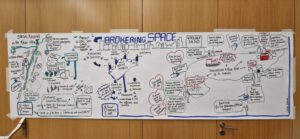
During the workshop, a graphic recording was created, i.e. a visual transcript of a meeting, workshop or lecture: key ideas, discussions and concepts are recorded live on paper or digitally as images, symbols and short texts, making the content immediately understandable and memorable.
You can follow the full article and graphic video on Alliance of the Alps website HERE.