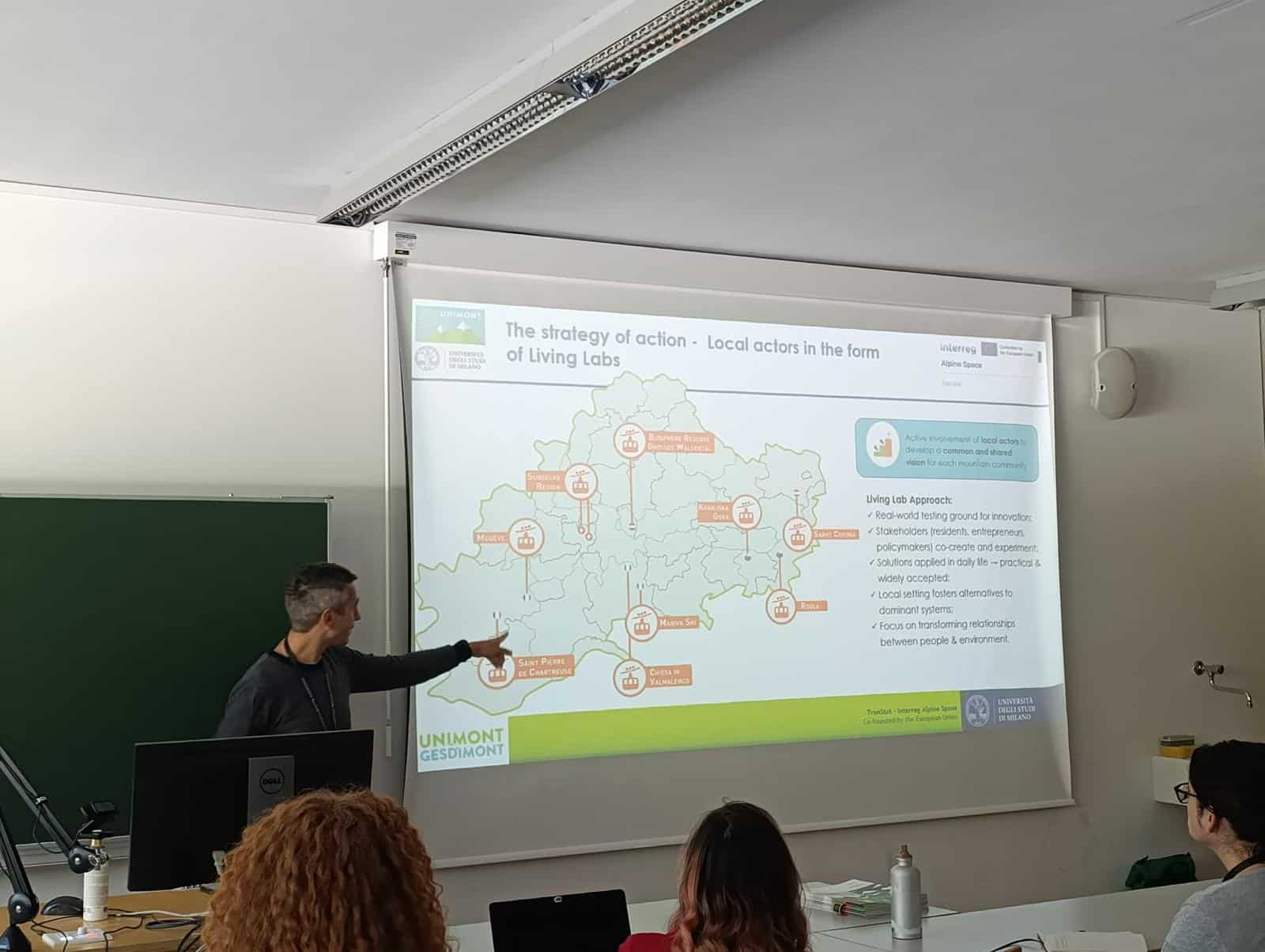
INRAE and EURAC co-organized with UNIMONT, the workshop Transition processes of mountain resorts and tourism destinations : state of the art, levers and barriers. An international perspective.
The workshop aimed to debate the ongoing transition experiences of mountain resorts and destinations, in particular those worked within the framework of the ongoing Interreg Alpine Space projects “BeyondSnow” (LP EURAC) and “TranStat” (LP INRAE). In line with its international approach, the workshop welcomed presentations of case studies and experiences from Italy, France, Canada, New Zealand and Slovenia. Transtat experiences were represented by the cases of the LLs Saint Pierre de Chartreuse (France) et Kraniska Gora(Slovenie) : in the French case, analysed how a collective and participatory approach in the region led to a reduction in the use of the ski area, with two ski lifts operators (on 2 sites) for five years. They also show that this decline in skiing has not been accompanied by a decline in tourism, with discussions now underway on how to welcome tourists. The Slovenian case, SRZU presented the efforts that are being made to diversify winter tourism and reduce dependence on skiing. For instance, local stakeholders propose developing a new ski resort management model to reduce uncertainties related to private ownership of ski lifts; in this context, a participatory approach to identifying transition processes and development visions is crucial. SRZU presented also the transitions’ pathways based on the 9 case-studied in TranStat, with 4 clusters (1. Latent transition withweak or no governance support for transition and a narrow scope ; 2. Bottom-up transition with weak governance support for transition, but a broad scope ; 3. Adaptive transition of tourism sector with a strong governance support for transition, but a narrow scope ; 4. Strategic sustainable transition with a strong governance support for sustainable transition and also a broad scope).This typology was debated with the participants and applied to the other international experiences.
Insights from Transtat experiments were also presented in other sessions, as :
Transformative changes towards Living Well in mountains: How does it feel?
This session, organized by Iago Otero and Anna Giorgi, Kirsten Koop, Annemarie Polderman, Carolina Adler and Theresa Tribaldos, invited communications that described research projects combining diverse knowledge domains to exploretransformative pathways towards Living Well in mountains worldwide, at different scales
The communication from UGA and INRAE showed the study carried out among the permanent residents of ourLL Saint Pierre de Chartreuse to adress the notion of living well from a social perspective. The surveyhighlighted the existence of different profiles of residents in terms of their geographical origins and residentialpathways. The study also explored the socio-demographic characteristics of these different groups, their identity-based attachments to the territory at different scales, their attitudes regarding climate change, and theirrelationships with the ski resort, tourism, local life and its evolution. It showed that although the groups holddifferent positions on some topics, they share many similarities in their relationship to the place. Understandingthe differences while building on this common ground, and creating open spaces for dialogue, appear to be key elements in contributing to living well in mountain territories.
Innovative Approaches for Mountain Resilience: Bridging Practice, Science, and the Private Sector.
This workshop, organized by Paola Fontanella Pisa, Stefan Schneiderbauer, Ansgar Fellendorf, Eleonora Musco,Susanne Wymann and Harald Egerer, focused on innovative solutions addressing sustainable mountain development issues and discussing enabling factors as well as ways of how science can act as a bridge between practitioners’ capacities, environmental goals, societal needs, private sector interests, and effective policyframeworks.
Unimont highlighted the added-value of participatory transition processes, involving a broad range of local stakeholders—residents, businesses, youth, tourism representatives, and local authorities. By encouragingcollaborative decision-making, the project ensures that the voices of all community members are heard in shaping solutions. In order to include these actors in the dialogue, various participatory tools were used, both on the final target group and among the working group with a view to cross-pollination.
To serve this concept, Unimont presented the case study of one of italian LLs, Maniva Ski a peculiar ski resortdivided between two very different municipalities. Low altitude and unfavourable exposure threaten the openingof the ski resort every winter. However, the real threat is the lack of involvement of the communities belongingto the municipalities, which are distant and in the process of depopulation.
In conclusion, TranStat’s contribution to this worldwide event dedicated to research in and for mountain areas has been substantial and highly visible, bearing witness to the capabilities of TranStat and its consortium toconnect experiences across the Alps, to create a cross-border network for knowledge exchange. This collaboration strengthens the resilience of ski resorts by sharing best practices and innovative strategies, helpingcommunities adapt to climate impacts more effectively.