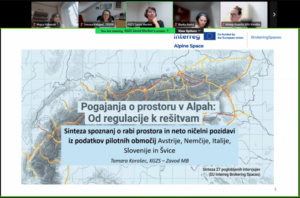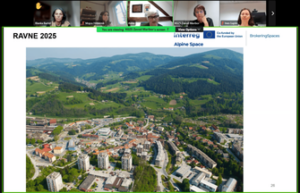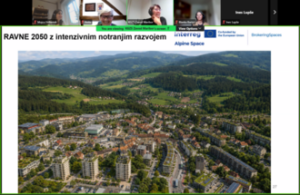

Two Local Round Tables were conducted in the framework of the pilot site of Ravne na Koroškem (Slovenia), contributing to the development of practical approaches for sustainable land-use management and the transition towards No Net Land Take.
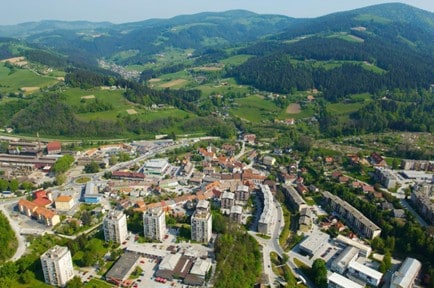
The first workshop brought together representatives from municipal and regional planning, ministries, agriculture, forestry, tourism, regional development and other stakeholders to discuss the increasing pressures on land use in the Koroška region. The discussions highlighted the specific spatial reality of the area, characterised by narrow valleys, steep forested slopes and heavily built-up flat land, leaving very limited opportunities for further expansion. The discussions focused on how future development could increasingly rely on renovation of existing buildings, inner development, densification, mixed-use approaches and the revitalisation of underused areas instead of outward expansion. At the same time, the workshops revealed the diversity of perspectives attached to land use. Municipalities emphasised the need for economic development and viable settlements, farmers highlighted the importance of preserving fertile agricultural land and maintaining active farming, while tourism representatives stressed that preserved landscapes and nature are essential for long-term regional attractiveness. Nature protection and forestry stakeholders further pointed to the growing pressure on ecologically sensitive areas and forests with important social and environmental functions.
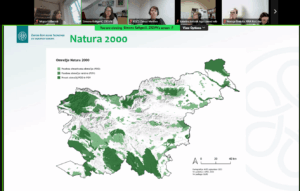
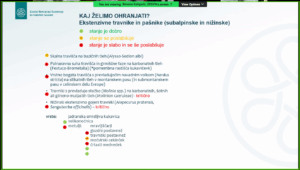
The second Local Round Table deepened the discussion by introducing perspectives from nature conservation and constructive negotiation approaches in spatial planning. A central topic was the distinction between nature conservation and environmental protection, as well as the role of Natura 2000 areas, ecological corridors and habitat protection within spatial planning procedures. The discussions demonstrated that many of the strongest land-use conflicts emerge precisely in agricultural landscapes and less intensively used areas, which are often highly valuable from a biodiversity perspective while simultaneously attractive for development pressures. Participants stressed that sustainable land-use governance cannot rely solely on restrictions and prohibitions, but requires positive incentives, long-term cooperation and stronger support mechanisms for municipalities, landowners and farmers. Several concrete approaches and possible instruments for more sustainable spatial governance were identified during the discussions. These included stronger land policy instruments, incentives for renovation and activation of vacant buildings, regional coordination of industrial and development zones, institutionalised mediation mechanisms, financial instruments supporting circular spatial management and better use of spatial data and land-use monitoring systems.
Workshops in Slovenia conclude that sustainable spatial development requires stronger cooperation, early stakeholder involvement and a better balance between development needs and the protection of agricultural and natural land. Participants agreed that inner development, renovation and the activation of vacant areas will be essential for reducing future land take.