CIPRA (Commission Internationale pour la Protection des Alpes) is an independent non-governmental and non-profit umbrella organisation, committed since 1952 to the protection and sustainable development of the Alps. With its international executive office in Liechtenstein, its national representations in seven Alpine countries and beyond, and around one hundred member organisations, CIPRA today is an important Alpine-wide network.
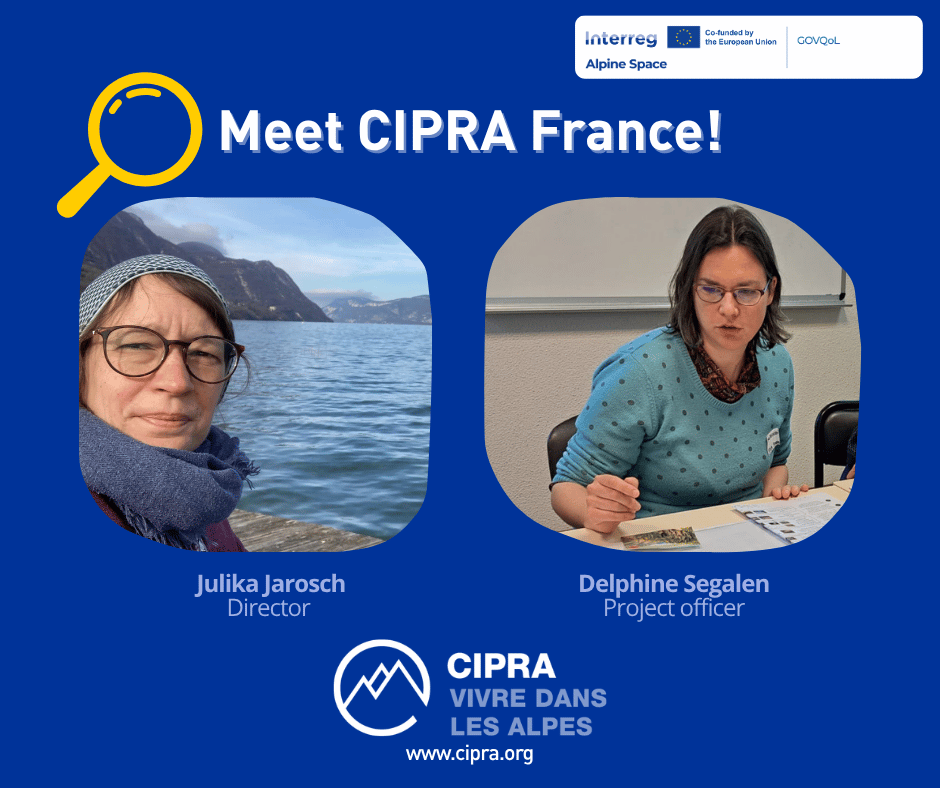
Julika Jarosch and Delphine Segalen are respectively co-director and project officer at CIPRA France.
What would be your personal definition of « Quality of life »?
Delphine: In my view, a good quality of life requires well-developed public services (particularly for families), the ability to get around safely without a car, a pleasant living environment, green spaces, and places where people can socialise and express their ideas. Access to leisure activities and nature for all sections of the community, as well as air quality and the environment, are also important factors.
Julika: For me (as a big city girl), quality of life means to have the possibility to interact with people easily (social interconnection) by having the places to meet new people (as in associations,…) and the spaces to spend time in (coffee shops and bars), cultural input available (as library, theatre, cultural activities proposed in the town), accessibility (mobility or at least good bicycle ways), access to basic services, green infrastructure, …
In your own words, what is your role in the GOVQoL project?
Apart from coordinating with the two French pilot territories, CIPRA France is in charge of project communication.
Why do you consider this level of governance important for quality of life?
Delphine: Local authorities, through their day-to-day contact with residents, play a vital role in ensuring a good quality of life. They have the power to listen to and address the issues raised, or to refer them to higher levels of government if they lack the necessary remit.
Julika: It’s the humans who create and influence their environment… to make it better or even less. If the locals don’t get involved, a lot of decision are often taken against their needs and wishes. In rural areas probably even more needed than in urban areas, as the influence can be much higher and the success / outcome of engagement on local level can be more easily visible and reached. In times like these and less willingness of engagement a kind of frustration / thinking like ‘it won’t change anything if I get involved, no-one is anyway listening to me” is installed… how can this be changed ? (no answer on this yet from me personally), my professional answer would be : create the social connection between the people, communicate – o they create social hub to make the change
Thanks Delphine and Julika!
To know more about the work CIPRA does, please visit https://www.cipra.org/en/cipra