

The 2nd Italian National Forum on Energy and Sustainability (April 21–23), promoted by Duezerocinquezero and hosted in Padua, represents one of Italy’s key moments for discussion on energy transition topics. The event brings together major national stakeholders – institutions, companies, energy sector operators, and the scientific community – fostering structured dialogue between public policies, technological innovation, and territorial implementation.
The Forum focuses on some of the most relevant challenges for achieving European climate goals: integration of renewable energy sources, energy efficiency, development of energy communities, digitalization of energy systems, and new models of multilevel governance. In this context, particular attention is given to the role of cities and territories as laboratories for the transition, in line with EU priorities and transnational cooperation programs.
The first day opened with an auditorium session dedicated to geothermal energy, titled “Geothermal Energy Without Excuses,” exploring the potential of low-enthalpy geothermal solutions and next-generation district heating and cooling networks, including so-called “cold networks.” This topic aligns with innovation pathways reshaping urban energy systems, based on greater integration of renewable sources, heat recovery, and network flexibility. Prior to the ALPHA project presentation, other district heating-related projects were also introduced, including “Road Infrastructure and Thermal Storage for District Heating: Innovation for Urban Districts,” helping to outline a comprehensive overview of emerging solutions in the sector.
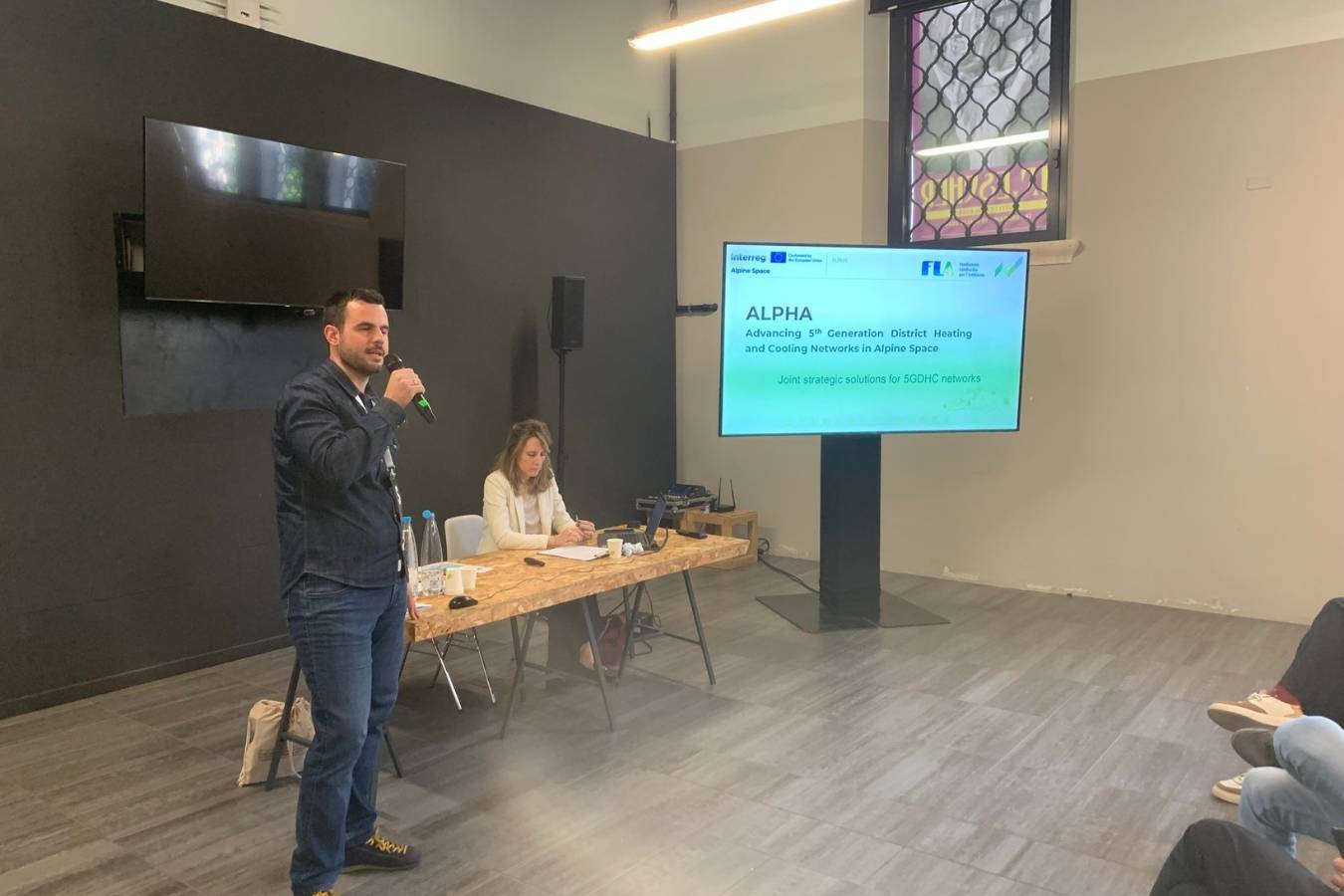
Within this framework, the ALPHA project – funded by the Interreg Alpine Space Programme – aims to simplify and accelerate the planning and development of fifth-generation district heating and cooling networks (5GDHC) across the Alpine Space.
ALPHA was presented by Giovanni Dalle Nogare of Eurac Research with the talk “Heat Mapping as a Lever for Urban Energy Transition,” highlighting the strategic role of spatial data and territorial analysis tools in supporting decision-making processes. The presentation demonstrated how mapping heat demand and supply—including waste heat recovery potential and local renewable resources—can provide an operational foundation for planning integrated energy systems, contributing to the development of energy communities and positive energy districts.
The presentation also provided a structured overview of project activities, including a detailed description of the three work packages and related actions, such as study visits across partner territories. Particular attention was given to Vienna as an advanced example of integration between urban and energy planning. The project’s multi-scale approach was also illustrated, analyzing and supporting energy network design at different levels—from individual buildings or condominiums to urban blocks and district scale—highlighting the need for flexible tools adaptable to diverse territorial contexts.
The key message that emerged is the need to equip territories with operational, data-driven tools to guide the energy transition: from heat mapping to the definition of replicable intervention strategies. In this sense, the ALPHA Project contributes to building a shared and transferable methodological framework to support public decision-makers and stakeholders in developing efficient, integrated, and decarbonization-oriented 5GDHC networks.