
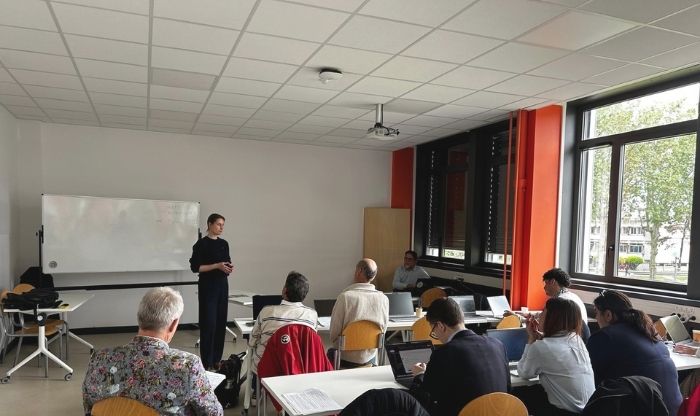

The ALPHA project partners gathered at INSA Lyon in Villeurbanne, France, on 6 and 7 May to collaborate on practical examples of 5th Generation District Heating (5GDH) network development, also known as Thermal Source Networks.
The ALPHA project, co-funded by the Interreg Alpine Space programme, aims to accelerate and facilitate the development of 5th Generation District Heating systems, which are more efficient, fully decarbonized, and based on low-temperature operation.
On 6 May, all partners took part in presentations of their pilot sites, moderated by Morten Duedhal, Business Development Manager at DBDH (Danish Board of District Heating), an association representing the country’s leading district heating companies, and Nicolas Picou, Renewable Heating and Cooling Engineer at AURA-EE, the regional energy agency of the Auvergne-Rhône-Alpes region.
The pilot sites were divided into two categories: large-scale and small-scale projects. Large-scale projects represent regional initiatives or projects involving major cities, while small-scale projects range from two-building systems to solutions serving small towns.
The following pilot sites were presented:
- Liguria Region, Italy
- Lombardy Region, Italy
- City of Munich, Germany
- District Heating Network of Villefranche-sur-Saône, France
- City of Genoa, Italy
- City of Tyrlaching, Austria
- Garbejaire district, city of Valbonne, France
- City of Vienna, Austria
- Trebnje pilot site, Slovenia
During the workshop, several discussions focused on the technical and financial aspects of developing 5th Generation District Heating systems across the Alpine region. One of the key issues raised was the importance of ensuring stable legal and subsidy frameworks for 5GDH development, avoiding “stop-and-go” policies that can negatively affect stakeholder strategies and, in some cases, be more damaging than the absence of subsidies altogether.
Another crucial point highlighted during the discussions was the need to carefully define the study perimeter to ensure project feasibility. Key parameters include stakeholders’ decision-making processes and financing capacity, sufficient heating and cooling demand, renewable energy potential, and effective management of heat distribution temperatures.
Overall, the workshop confirmed that the development of 5th Generation District Heating is achievable when stakeholders are adequately informed and engaged through a multi-criteria approach to heating and cooling challenges. Important factors include long-term economic sustainability, CO2 emissions reduction, greater resilience to climate change, and the engineering, operational, and maintenance capacities of local companies.