The BAUHALPS project introduces an innovative model that supports the transition to a more sustainable and circular building sector in the Alpine region. The model combines the principles of the circular economy with the values of the New European Bauhaus (NEB), which promotes sustainability, aesthetics, and social inclusion in architecture and construction.
The BAUHALPS Model focuses on reducing waste, improving the reuse of materials, and encouraging environmentally responsible construction practices throughout the entire life cycle of buildings. At the same time, the project highlights the importance of preserving local identity, traditional building techniques, and the cultural heritage of Alpine regions.
An important aspect of the model is the integration of modern technologies with traditional knowledge and local materials. Through this approach, the project aims to create construction solutions that are not only sustainable and resource-efficient, but also aesthetically appealing and adapted to the specific characteristics of local communities.
The project also develops practical tools and methodologies for assessing the circularity and sustainability performance of buildings. These tools will be tested through pilot projects on different types of buildings, including residential, public, cultural, and historical structures across the Alpine area.
In addition, the BAUHALPS project encourages strong collaboration between architects, researchers, companies, public institutions, and local communities. By involving different stakeholders in the co-creation process, the project supports innovative solutions that respond to both environmental and social challenges.
The final goal of the BAUHALPS Model is to provide long-term guidance and practical solutions for greener, more circular, and more resilient construction practices in Europe.
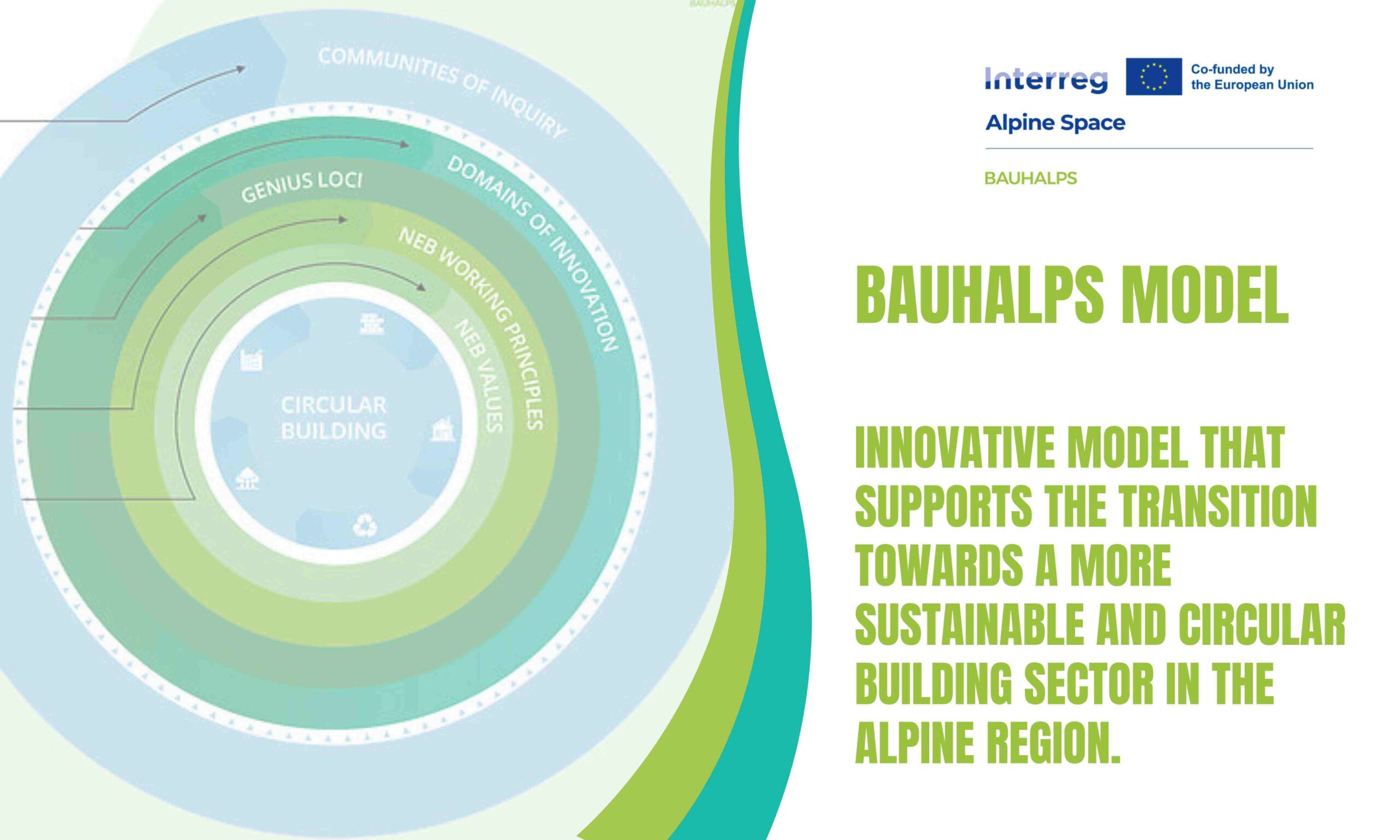
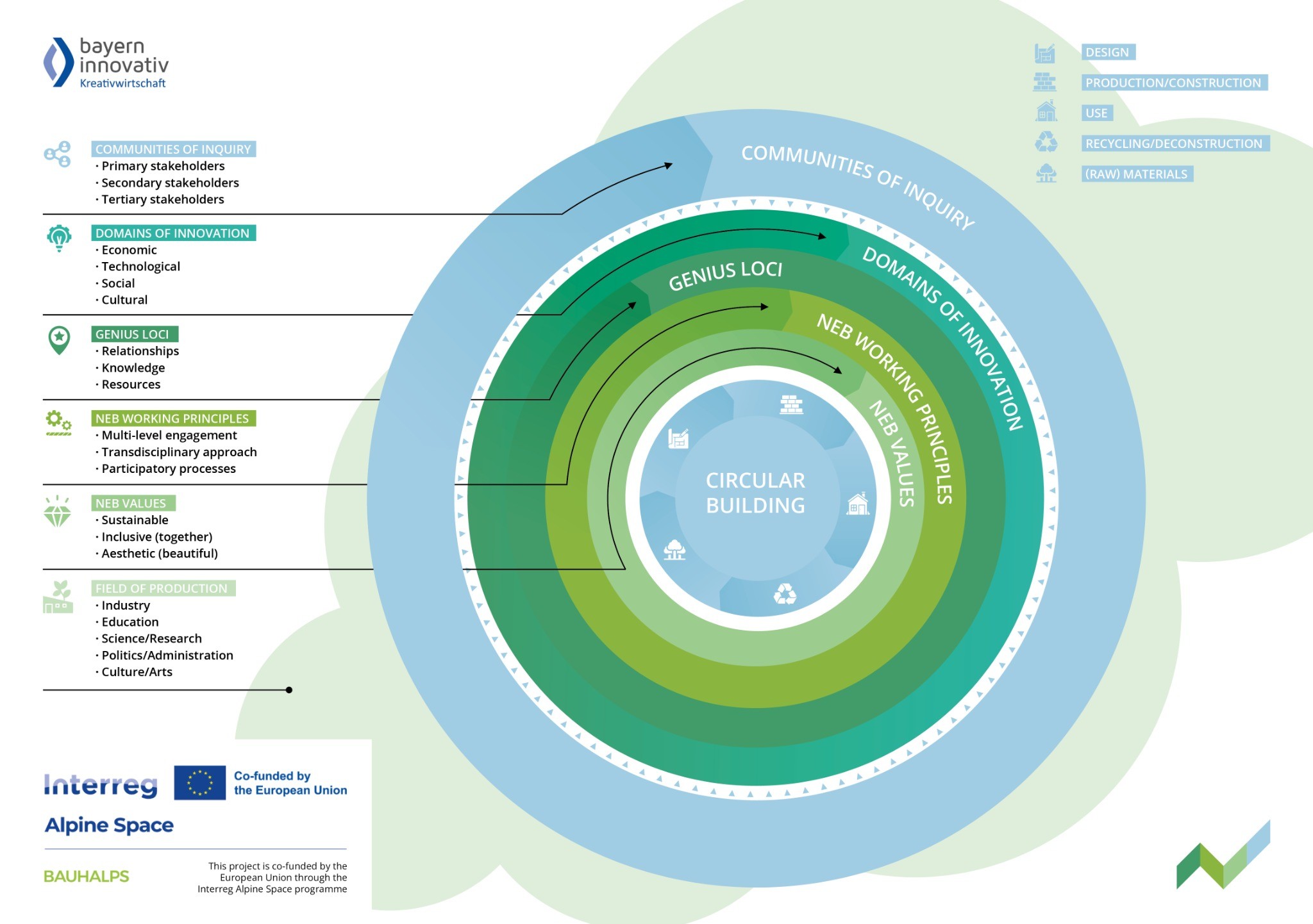
The diagram illustrates the structure and main components of the BAUHALPS Model. At the centre of the model is the concept of circular building, which represents the core objective of creating sustainable, resource-efficient, and environmentally responsible construction practices. Around this central element, several interconnected layers demonstrate how different aspects contribute to the overall transformation of the building sector.
The inner layers focus on the values and principles of the New European Bauhaus (NEB). These include sustainability, inclusiveness, and aesthetics, together with participatory processes, transdisciplinary cooperation, and multi-level stakeholder engagement. The model highlights that sustainable construction should address not only environmental goals, but also social, cultural, and aesthetic dimensions.
Another important layer of the model is the concept of “genius loci”, which refers to the identity and character of a specific place. This includes local knowledge, relationships, traditional building techniques, and available regional resources. By integrating local heritage and cultural identity into modern construction practices, the model supports solutions that are both innovative and adapted to local environments.
The outer circles represent broader domains of innovation and collaboration. These include economic, technological, social, and cultural innovation, as well as the involvement of different stakeholder groups through “communities of inquiry”. The model therefore promotes cooperation between industry, education, research institutions, public administration, and cultural sectors.
The diagram also reflects the entire life cycle of buildings, from raw materials and design to construction, use, recycling, and deconstruction. In this way, the BAUHALPS Model demonstrates a holistic approach to circular construction, where environmental responsibility, innovation, local identity, and community participation are closely connected.