
Within the framework of the ALPHA project meeting held at INSA Lyon in Villeurbanne, France, on 6–7 May, a conference took place on 7 May, organised by AURA-EE and dedicated to 5th Generation District Heating. The session featured the Ferney-Voltaire district heating project as a concrete case study of implementation.
This project demonstrates some of the key technical solutions for low-temperature district heating. In the newly developed area, all buildings under construction are highly energy efficient and connected to a two-pipe district heating and cooling network, which supplies tempered water at 25–30°C. The heating and cooling pumps are operated to ensure the highest efficiency ratio.
The district heating and cooling system is supplied via heat exchangers connected to the nearby CERN particle accelerator, as well as to waste heat from a wastewater treatment plant. Heat is stored in around 100 geothermal boreholes at a depth of 125 metres, in order to ensure continuity of supply when the CERN accelerator is shut down every five years for technical inspections. The network will provide 20 GWh of heat and 6 GWh of cooling.
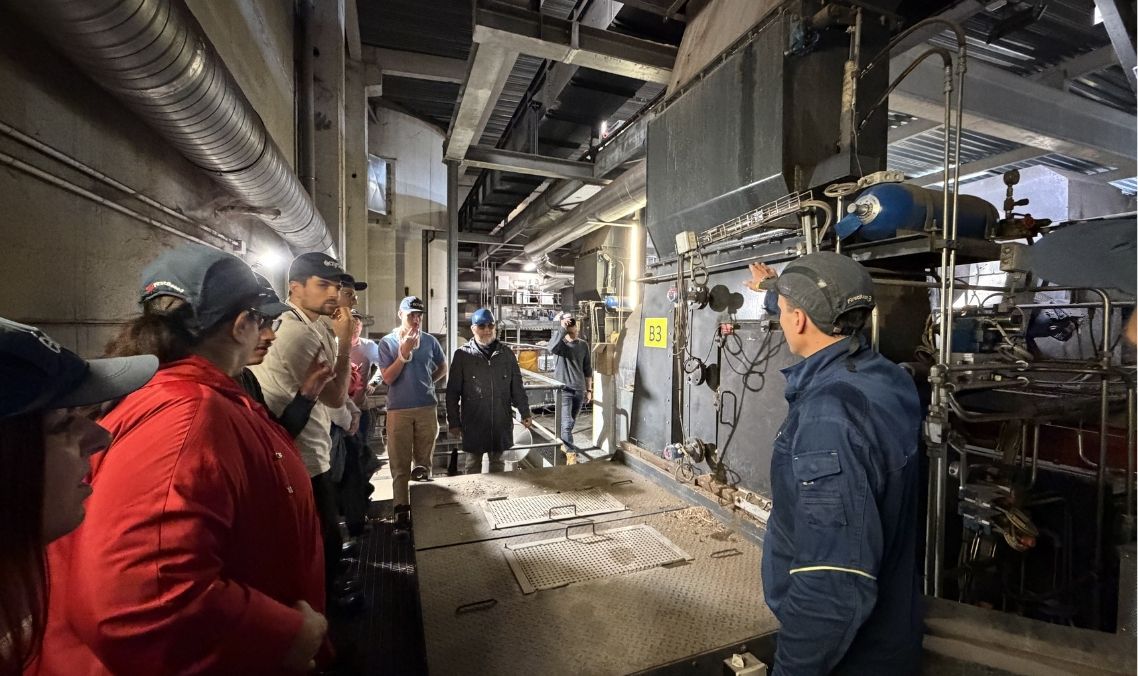
The partners were also invited to visit a demonstrative district heating plant located in Vaulx-en-Velin and operated by Dalkia. The Vaulx-en-Velin district heating network is owned by Lyon Metropole and operated under a long-term public service delegation contract awarded to Dalkia.
The system is 28 km long and supplies approximately 185 GWh per year to the equivalent of around 19,000 households. Its average renewable energy share of 75% is ensured by three 7 MW biomass boilers. The steam from the boilers, after filtration, is condensed to provide an additional 5–8% renewable heat through heat pumps connected to the district heating return pipe. The return temperature must be sufficiently low to allow the use of this low-temperature heat source. The refurbishment of the network carried out in 2023 made it possible to reduce the maximum operating temperature from 164°C to 110°C and the pressure from 16 bar to 4 bar.
The partners were particularly interested in the challenges encountered during the network transformation, such as lowering the operating temperature of biomass boilers, managing ash and its use as fertiliser in agricultural fields, and the design of heat storage systems based on peak heat demand in the late morning, in order to avoid activating gas boilers instead of wood-fired boilers, which respond more slowly.
ALPHA is co-funded by the Interreg Alpine Space programme.