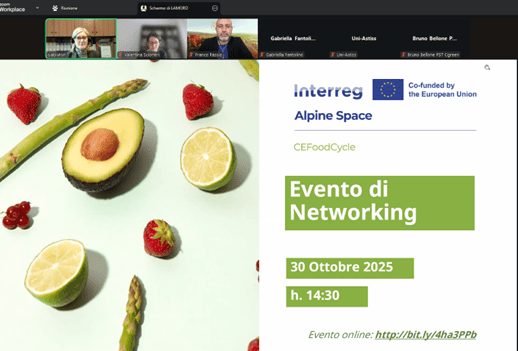
On 30 October 2025, LAMORO Development Agency hosted an online networking event to mark the conclusion of the CEFoodCycle project, financed by the Alpine Space Programme 2021-2027.
The meeting provided an opportunity to present the project’s achievements, explore future strategies, and strengthen collaboration among stakeholders.
Participants were introduced to the main deliverables available on the project website, including the digital tool FoodCycle.ai, training materials, and outputs developed through pilot actions implementation. The discussion specifically focused on the outcomes of LAMORO’s pilot action, which assessed the potential to close local food loops and examined impacts from environmental, economic, and social perspectives. Key points included resource and material management, business model sustainability, and value creation for stakeholders. Additionally, examples of the active involvement of local actors were recalled, including the organization of innovation labs and workshops, participation in networking activities, and the monitoring of the “Uovo Circolare” initiative, together with the finalization of an analysis of challenges and future opportunities. In conclusion, the event also showcased pilot actions implemented by other European partners, with the aim to boost transnational learning among the participants.
The discussion which followed LAMORO staff presentation offered valuable reflections and perspectives for future development: key contributions included experts and stakeholders from academia, private sector, and regional authorities. They all underlined the relevance of CEFoodCycle within a broader context of sustainable innovation. Moreover, they emphasized the importance of collaboration among research, businesses, and public institutions to promote circular practices in the agri-food sector and ensure continuity of project actions. Future opportunities were discussed, with regional representatives highlighting funding mechanisms and upcoming calls that could support the work initiated. The meeting concluded with an invitation to endorse the petition “Together We Can Give Food a Second Life!”, promoted by CEFoodCycle as a symbol of collective commitment toward a more sustainable and circular food system.
The event saw active and constructive participation from local stakeholders who have supported the activities throughout the project. A total of 16 participants representing 10 organizations joined the meeting, including public authorities, research institutions, SMEs, business support organizations, and civil society associations. Among them were the Piedmont Region – Directorate for Environment, the Management Authority of the Royal Parks Protected Areas, Covar-14 Consortium, the University of Gastronomic Sciences of Pollenzo, UNI-ASTISS University Hub of Asti, CGREEN Innovation Cluster, Fantolino Farm, and associations such as Circular Economy for Food, Mercato Circolare, and INNUVA.