

Climate change is no longer a distant threat—it is already reshaping life and livelihoods in Alpine mountain resorts. The TranStat project supports these regions in rethinking their future through sustainable transitions.
Rather than offering a single route, transition pathways are structured, locally rooted trajectories of change. They reflect how place-specific factors—social norms, economic models, environmental care, governance, and technology—shape the course of transformation. For Alpine resorts, this might mean diversifying beyond winter tourism, reimagining infrastructure, or empowering local communities.
What is a transition pathway?
A transition pathway captures the long-term, systemic shifts needed to achieve sustainability. It goes beyond technology, calling for coordinated changes in behaviour, governance, economic practices, and environmental protection.
Sustainable transition pathway typology
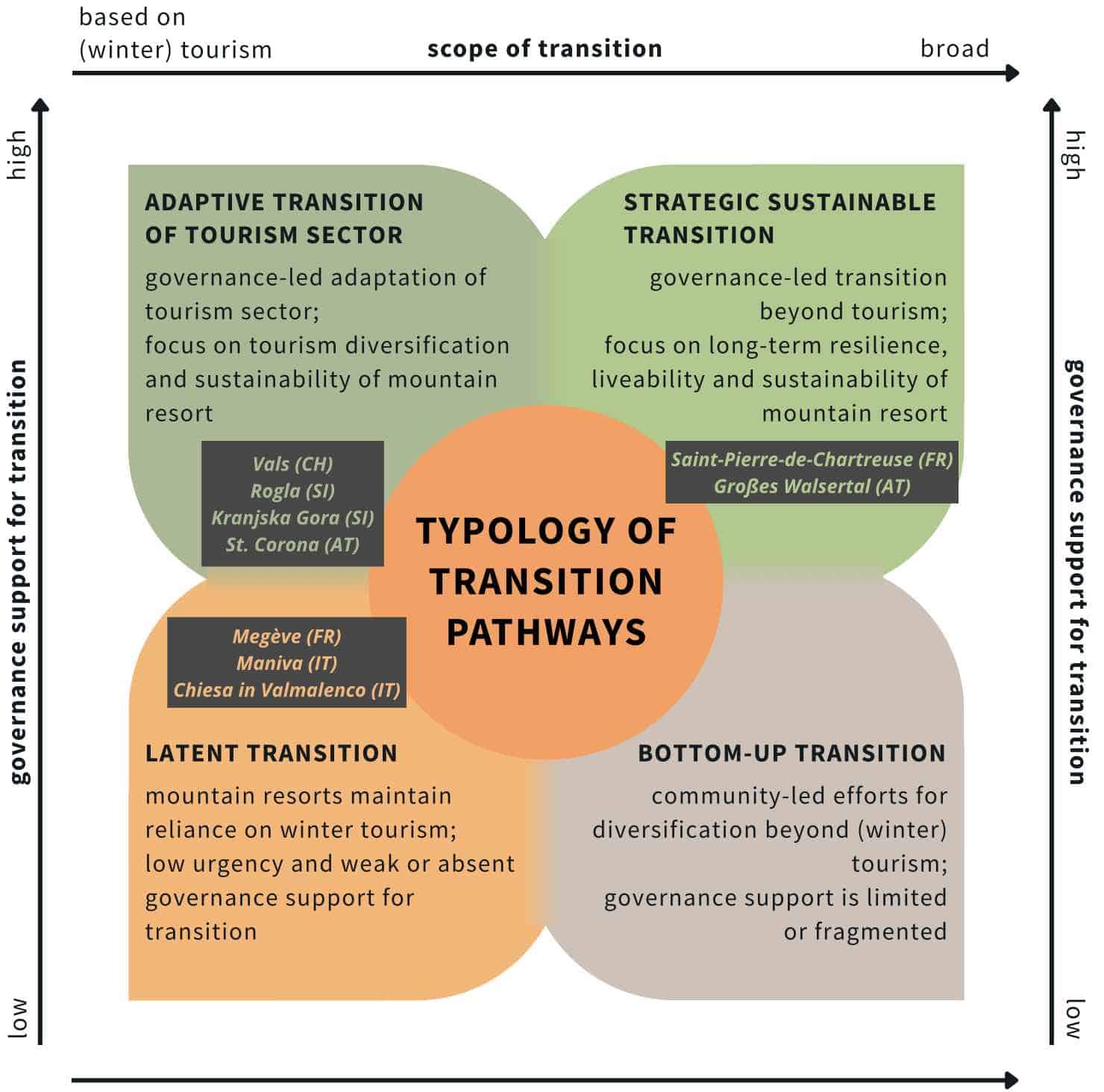
TranStat identified four main types of transition pathways that differ in terms of governancesupport for sustainable transition (low vs. high) and with regard to what scopes of transitionthey pursue (tourism diversification vs. broader socio-economic and environmental transformation):
The typology doesn’t offer one-size-fits-all solutions. Instead, it reflects the diversity of Alpine contexts, helping mountain resorts rethink their future development orientations, appropriate governance approaches and build resilient, place-based futures.
Transition pathways in practice: TranStat Living Labs
Findings from the TranStat project reveal diverse transition pathways of Living Labs, strongly shaped by local contexts. Even within the same type, trajectories vary: Megève, Maniva and Chiesa in Valmalenco all follow latent transition with limited governance support—Megève remains rooted in ski tourism, while individualised initiatives in Maniva and Valmalenco promote eco-sustainable offers. Adaptive transitions, such as St. Corona, Kranjska Gora, Rogla, and Vals, pursue adaptive diversification of tourism, but keep skiing as central. Strategic transitions, seen in Saint-Pierre-de-Chartreuse and Großes Walsertal, move beyond skiing toward low-impact, year-round models centred on ecology, resilience, and liveability. As Saint-Pierre-de-Chartreuse was long dependent on ski tourism, it faces a deeper systemic shift, while Großes Walsertal builds on its tradition of diversified, low-impact tourism. Together, these cases show how Alpine destinations rethink their futures through varying governance support and scopes of transformation.
Author: Maruša Goluža, ZRC SAZU