
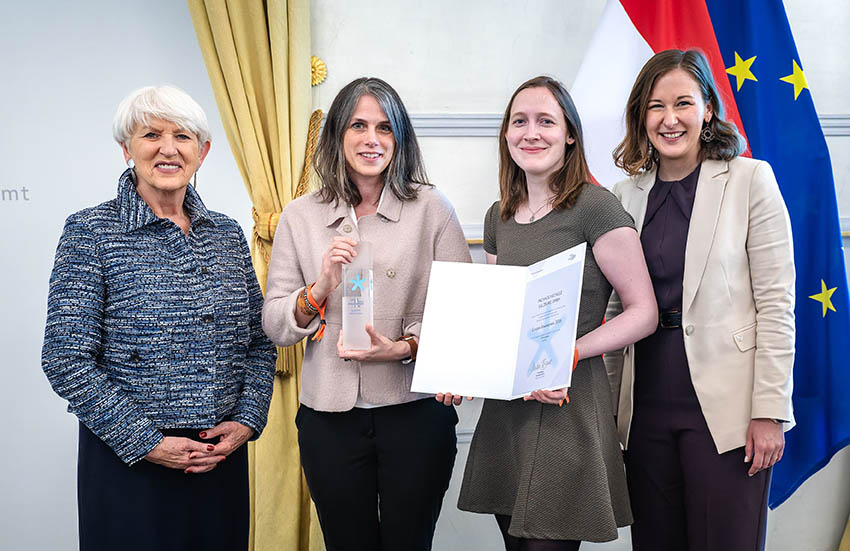

We are proud to announce that the Interreg Alpine Space project CEFoodCycle focused on circular economy in the food sector, has been awarded the EuropaStaatsPreis 2026 in the category “Transforming Europe”. The award was presented on 6 May 2026, bringing a fitting close to a project that has spent three years turning a global challenge into local action.
From a shared challenge to concrete solutions
Food waste is a critical sustainability issue. Across Europe, vast quantities of food are lost or discarded each year, generating CO₂ emissions and undermining food security. CEFoodCycle set out to tackle this challenge head-on by empowering the people and businesses who make daily decisions about how food is produced, used and managed.
Active since 2022, the project brought together stakeholders and partners from five Circular Food Hubs spanning Italy, Austria, Germany, Slovenia and France, building a network of circular economy food hubs at the heart of the Alps. Coordinated by the University of Applied Sciences in Salzburg (AT), the initiative worked across the full food value chain – from producers and manufacturers to restaurateurs, hotel operators and energy providers – to identify opportunities to reduce waste, cut costs, and close food cycles.
Knowledge as a catalyst for change
What set CEFoodCycle apart was its commitment to knowledge transfer. The project did not simply study the problem; it gave others the tools to act on it.
Its decision-support platform FoodCycle.ai is at the centre of this approach, helping users identify and evaluate options for reducing food waste and surplus by providing structured recommendations and relevant partNers to continue building a more circular food system. By increasing transparency along food streams and connecting relevant stakeholders, the tool enables more sustainable decision-making at every level of the supply chain. User feedback shaped the platform throughout its development, with mock-up and tool tests carried out with more than 70 participants from across the Alpine Space region.
The results reflect real traction: a database of 450 companies was established during the project period, with a particular focus on organisations that redistribute surplus food for human consumption; including food banks. Between January and October 2025 alone, the platform registered 2,000 users. Uptake was driven through the five Circular Food Hubs using a mix of newsletters, events, higher education courses and conference presentations.
Beyond the platform, CEFoodCycle ran workshops and hackathons to spark innovative thinking and connect stakeholders across the Alpine region. These gatherings fostered the kind of cross-sector dialogue that is essential for systems-level change — bringing together small enterprises, industry players and local institutions to co-develop solutions tailored to their territories.
The results of the project speak for themselves: measurable reductions in food waste, lower CO₂ emissions, and a growing community of professionals equipped to continue the work independently. These outcomes are precisely what the “Transforming Europe” category of the EuropaStaatsPreis recognises: initiatives that connect European ideals to tangible regional change.
A project that ends, a movement that continues
CEFoodCycle has now closed, but the ideas and networks it generated are very much alive. The educational platform continues to be a resource for anyone looking to learn about circular food systems. The five food hubs established across the Alpine area serve as models for other regions. And the community of businesses, institutions and individuals who engaged with the project carries its spirit forward.
This is the sign of truly impactful cooperation that transforms equipping stakeholders to develop their own initiatives and inspiring a new generation of circular thinkers.
CEFoodCycle has shown that collaboration between territories, institutions and citizens can produce concrete, lasting solutions for a more sustainable food system. The EuropaStaatsPreis is a well-deserved recognition of that achievement – and a reminder that the Alpine region is a place where transnational cooperation bears fruit.